It’s been my experience that when re-introducing people to Nature, two kinds of instruction are necessary. I call the process a re-introduction, because all of us are part of Nature; it’s only that in the rush and stress of urban life, many of us lose touch with the environment that we were created in. We are fortunate to have Bannerghatta forest at our doorstep, with so much scenic beauty! Here’s a photo of a pond near the Bannerghatta Zoo:
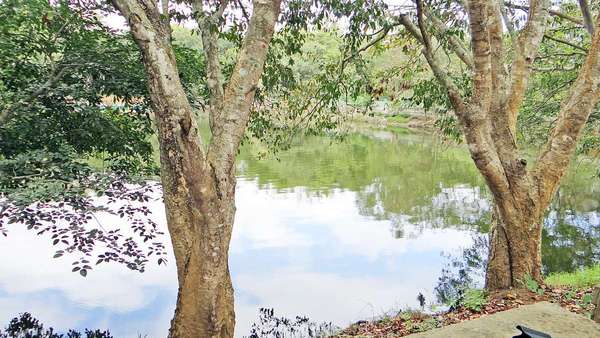
Kingfisher Pond in the Bannerghatta Zoo area. Pic: Deepa Mohan
On one hand, I feel strongly that a hands-on approach works much better than a dry, "classroom" type of lecture on the wonders that nature has to offer us. I can talk and talk about the various creatures that surround us, and how they live…but when I take a group of children, or adults, on a nature trail, showing them various things, I find that their appreciation of the joys that one can get, increases exponentially. For example, I was with three people at the Bannerghatta Zoo area earlier this week…and saw how both adults and youngsters responded to seeing and touching.
I had, in fact, entered the zoo after a long gap; animals in captivity make me feel quite sad. But since I could not access my usual trails any other way, we went into the Zoo…and though we did not pay too much attention to the captive animals, the variety of plant and bird life in the zoo was just incredible!
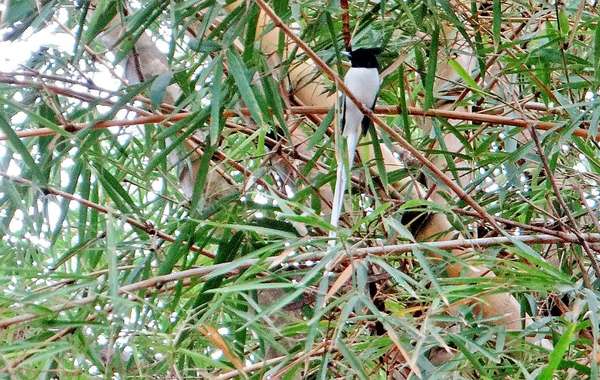
Birds know no walls or boundaries, and I found that the various beautiful, colourful Flycatchers were to be found as much in abundance within the zoo walls as outside them. I was able to show my friends some plants, too, and tell them interesting facts about them. I was just talking about how the bamboo is the fastest-growing grass in the world, when this beautiful Asian Paradise Flycatcher male made his appearance, delighting all of us!
Meanwhile, I saw that a zoo staffer had brought out a white rabbit, and some children were petting the animal. The look of rapture and delight on their faces was delightful to watch! I do feel that probably having domestic pets to look at, and handle, will be a great learning experience for the children.
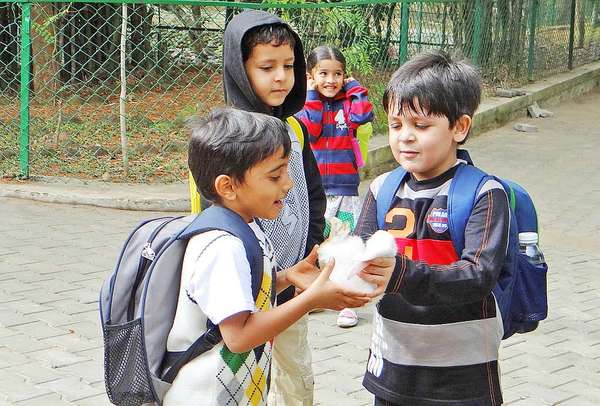
Here are Aham, Daksh, Krish, and Vedika, under the supervision of Subhashree (parent, not in picture), who are petting a rabbit brought by a zoo staffer. Pic: Deepa Mohan
When I showed the three adults I was with, the egg-cases of the Tent Spiders, and the beauty of the webs, they were also interested in more than just looking for birds.

The photos above show the spider webs, “tent”-like structures, in the hedge. Pic: Deepa Mohan
All this "in-the-field" experience is one part of the introduction, but the other part is equally important too.
This is the second part, that explains that wild creatures are just that…not domesticated..and therefore, one must maintain a respectful distance from a wild being at all times (except in emergencies) and must never touch or go too near. Approaching too close to a wild animal has two negative effects; it violates the animal’s personal space (don’t you feel stressed when strangers get too close to you in a lift or a bus?), and lays us open to the retaliation which are some animals’ reaction at being so distressed. We have to tell newbies about the ethics of observing wildlife, even if it is urban wildlife that lives amongst us; a caterpillar or a fledgling bird must not be touched or approached too close.
If we take this two-way approach to introducing people to the beauties that lie around them, waiting to be observed and enjoyed, we will make better naturalists ourselves, in being able to pass on the love of nature to our fellow-citizens, too.
All the photos in this post were taken on 30th December 2012 at the Bannerghatta Zoo and the nearby area.⊕
true, keep distance. Its always been so much more fun to watch what the animal is up to rather than disturb it and spoil all the fun. Be it wild or domestic, i think they all need their space.