Stella Rathna has been a part of the District Women’s Wing of the Dravida Munnetra Kazhagam (DMK) and was actively involved in politics for 15 years before being elected councillor of Ward 128. She is a resident of Palavakkam and has been elected from a ward reserved for women.
In an interview with Citizen Matters, she spoke about the key challenges in the ward with flood management and shared her vision for Chennai.
Ward No 128
- Name of Councillor: Stella Jasmine Rathna
- Party: DMK
- Age: 43
- Educational qualification: M.Com; LLB
- Contact: 9445467128
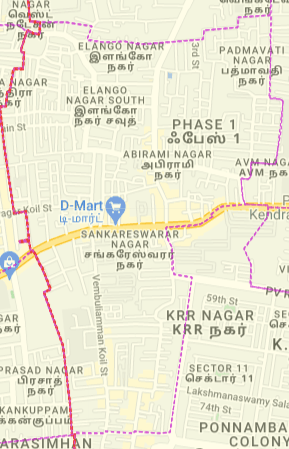
Primary goals for Ward 128
What are your three immediate targets for the ward?
This is the second largest ward in terms of population. The area is frequently prone to flooding. The rapid growth of the locality has led to many people settling here and building apartments in recent times.
We do not get Metro water here in parts and it is a key problem that many outside the areas are not aware of; this needs to be addressed.
The stormwater drain system issues in the ward have led to frequent and large-scale flooding. The fact that it needs to be fixed was established even before the elections, with the CM even visiting the ward. If you see here, many parts of the ward have stormwater drain work going on. My main task is to ensure that the work is carried out and there is no flooding when the monsoon comes around.
Another problem is the mixing of stormwater with sewage water. Be it illegal connections or an issue of capacity, the mixing of water and stagnation of sewage when there is any breakage in the drains is a problem that needs a permanent solution. I am working with the MLA and officials to address these issues on priority.
There may be practical issues such as funding but no lack of intent.
We don’t have any issues with waste management or electricity.
Read more: Four recommended steps for a flood-proof Chennai
How do you interact with the constituents? What kind of outreach activities have you held so far and plan to do? How can people in the ward contact you?
We get complaints from residents if there are any issues. We also visit sites where there is work going on. I interact with the public there. People are very aware of grievance redressal mechanisms and they use CM cell for complaints. People also ask around about what avenues they have to raise complaints.
A network of my office, officials and party workers all hear out the issues of the public and the message gets passed on to me. Then the complaints get addressed.
Waste concerns in Ward 128
What are your thoughts on privatisation of waste management in Ward 128? How can the operations be improved?
Post-privatisation garbage disposal has been executed well. There are some hiccups, where large apartments and establishments that are not under the ambit of waste management get dumped. There is also the issue of construction debris. If these are addressed, that would improve cleanliness. Any issues that we raise with the contractor have been immediately addressed. When the problems are pointed out they get rectified.
My experience in the ward has been good so it might benefit the rest of the city as well.
There has to be a solution for corporation workers affected by this move, by deputing them to other departments where the strength is insufficient. This is an issue being raised by other councillors as well.
Read more: Can Chennai ever become a bin-less city?
Vision for Chennai and Ward 128
What is your vision for Chennai as a city?
Completion of the metro would change the transport landscape. There must be more beautification work and infrastructural development across the city similar to the Kathipara Urban Square project. We must also find ways to attract tourists. Greenery must also be increased. I’m confident that this would be done under Singara Chennai 2.0.
What do you hope to achieve in your term as councillor?
Fixing the issue of stormwater drains even on link roads and interior roads is a goal for me during my term. Metro Water does not come under our purview but I would like to work with them to prevent sewage water leakage and contamination as that’s a problem that affects many residents.
What the residents of Ward 128 say:
Kasim M, a shopkeeper, says ” Floods have taken a huge toll on us. My shop incurred big loss the last time we had rains, so I hope the new councillors can help prevent floods and avoid a repeat of the issues.”
Kamalam R, a housewife, says ” We have constant construction around us and a lot of dust and noise. The owners dump garbage from the site on the street. This is a huge problem if you have elderly persons and children and those studying or working from home. Some action must be taken on this.”