Chennai’s character is defined by its resilience. The city powerfully rose to the occasion when it was hit by floods in 2015. Nature was not any kinder in 2016. Cyclone Vardah stripped the city of its green cover in December 2016. At least one lakh trees were uprooted in Chennai during Vardah, resulting in about 21 to 28 percent loss of green cover.
It was observed during Vardah that native trees survived the disaster but exotic trees perished in the calamity. This is because the former have a deep-rooted system while exotic species generally have shallow roots and cannot withstand strong winds. Experts also say it is especially important for Chennai to plant native trees that are fully adapted to coastal conditions.
Taking these factors into consideration, at least 20 organisations have come together to restore Chennai’s green glory. “This time we wanted the city’s resilience to sustain. We have hence planned to plant native trees that can withstand nature’s fury. This includes beech, Indian Tulip, neem, jamun, cannon ball tree, palm tree, mango tree and amla tree,” says Jegath Gasper, coordinator of the ReGreen Chennai movement.
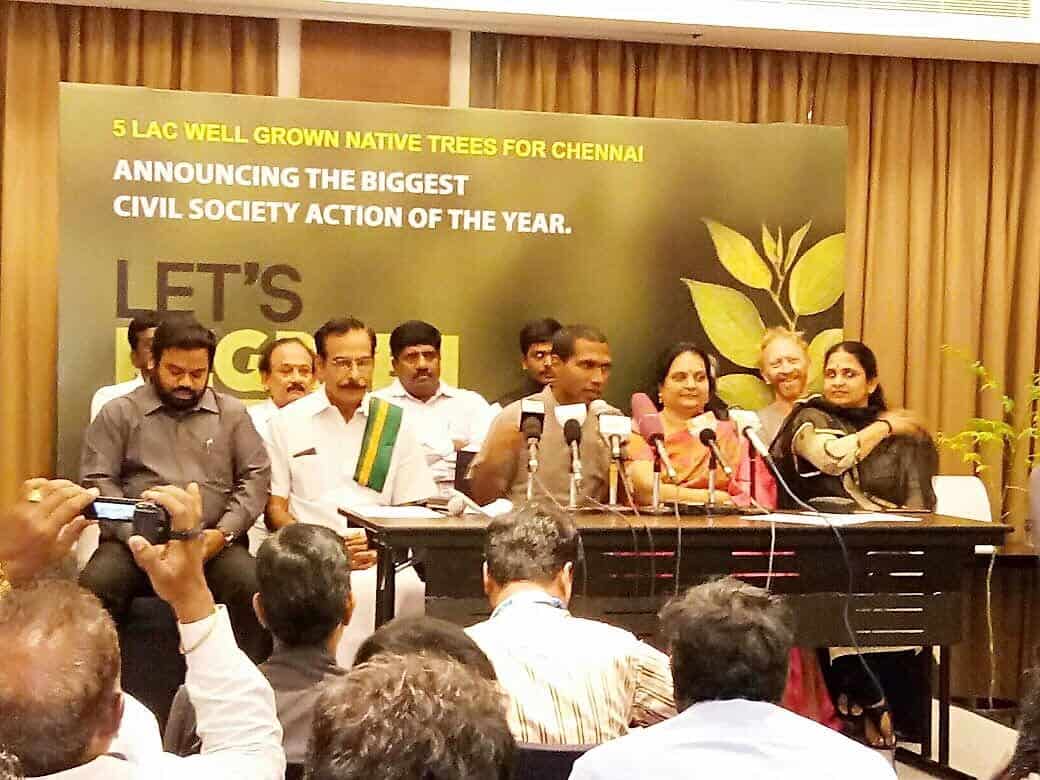
Gasper says the idea is to make it a people’s movement. “We are calling this movement ReGreen Chennai and we are hoping to involve as many organizations, institutions and individuals as possible. We hope to plant trees in institutions where constant monitoring and involvement is possible. In places where it is possible, we are hoping to build forests by planting trees and throwing seed balls.”
With a view to popularizing ReGreen Chennai, the movement will organize 100 conferences across the city in various schools and colleges, and hold three marathons for the purpose. “We hope this will raise awareness on native trees. We also have plans to educate the people on handling natural disasters. Volunteers who are familiar with disaster management are being trained for this purpose”.
Anchored by an organization called Earthsmiles, several other organizations including Rotary International, Osai, CREDAI, EXNORA, Y Men’s International, Federation of Tamil Nadu Farmers Association, Chennai Trekking Club etc are part of ReGreen Chennai. The movement hopes to plant five lakh trees over a period of five years.
“Before monsoons this year, we hope to plant one lakh trees with heights of not less than 4.5 feet. We also encourage organisations keen to build green cover to be a part of this project and are willing to guide them. We have also plans to reach 100 villages around Chennai and build green cover in the suburbs too,” Gasper says.
ReGreen Chennai will also set up temporary places where common people can obtain native trees to plant in their neighbourhood. The organisers will ensure that proper steps are being taken before planting a tree so that it has a greater life. “But above all, we hope this project will help restore the farmers’ emotional connect to the city” Gasper says.
The task might look daunting but Chennai is ready to take on.
Good start ,save planet ,save tree