On February 19th, the police had registered an FIR against 70 citizens, who took part in a silent march protesting the proposed Sankey road flyover. The protestors were accused of committing various crimes, including unlawful assembly, wrongful restraint, obstruction to any person in any public place. All of which are offenses punishable under the Indian Penal Code. This came to light only when notices were issued in the first weeek of April to those who had participated in the protest.
Some weeks later, in Yelahanka, another Bengaluru neighbourhood, several farmers who had been protesting the inadequate compensation provided by the BDA for acquisition of their land for the Shivarama Karanth Layout were compelled to give an undertaking that they would not hold any protests for a year and provide bonds and sureties worth Rs 1 lakh each to the police.
On April 10th, police detained several members of the Karnataka Rakshana Vedike, who staged a protest at the Mysore Bank circle against the Amul-Nandini merger.
The right to protest
These three incidents in quick succession may seem to be an aberration to those who have witnessed historic levels of protests by citizen groups in the city. In all these protests, citizens had come together to collectively exercise their fundamental right to protest. A right, which is protected under Article 19(1)(a)(Freedom of Speech and Expression), Article 19(1)(b) (freedom of peaceful assembly), and Article 19(1)(c) (freedom to form associations and unions) of our Constitution.
Yet, despite the constitutional guarantee on the right to protest, the fact is the space to exercise one’s fundamental right to protest is shrinking by the day in our city.
Read more: Residents of Sankey Road say flyover beda, will BBMP listen?
On April 6th, many citizens, residents’ welfare associations, activists, and other civic organisations came together to resist the police action against the Sankey Road protestors. The group met with the city’s police commissioner, Pratap Reddy, and urged him to withdraw the FIR, calling it an abuse of the law and a violation of their fundamental right to free speech, expression, and peaceful assembly.
Blame the High Court
It might surprise the reader to know that the police actions in all these incidents are perfectly legal on the ground that they were merely enforcing the law of the land. This is spelt out in the Licensing and Regulation of Protests, Demonstrations and Protest Marches (Bengaluru City) Order, 2021.
As per this law, it is illegal to protest anywhere in the city, except within the four corners of a part of the city’s former central jail, now ironically named Freedom Park. For which the protestors have to obtain a valid permit from the police.
Bengaluru, thus, cannot exercise their Constitutionally guaranteed fundamental right to protest anywhere else in the city beyond the confines of this small showroom of democracy. This law was enacted as a result of a public interest litigation initiated by the Karnataka High Court itself, in order to ensure smooth flow of vehicular traffic in the city.
In an earlier piece on this issue, I had critiqued the legitimacy of the intervention of the court and its ramifications. I had argued that this law constitutes an unreasonable restriction on the right to assemble peacefully and is therefore unconstitutional.
Read more: Sankey road widening: A project that doesn’t die
Two ramifications of this law need to be addressed here. One, the definition of ‘protest’ in this law is vague and overly broad-based. The wording allows the police to label any form of activism, where there is a gathering of one or more people, as a protest. Especially if they have gathered with the intention of expressing dissent or opposing or objecting to any issue, which may be ‘issue(s) including political, social, religious, cultural, farmers, workers or any other issues’ (sic).
Two, the restriction of all ‘protests’ and protest-related activities to Freedom Park, renders all aspects of protests meaningless, impractical, and ineffective. Especially as protestors are out of sight and sound of their target audience and restricted to shouting their slogans in front of large trees and barricades. These also hide the protestors from the general public, who pass in front of Freedom Park. As long as this law is in effect, the police will be able to restrict any type of activism in other parts of the city at their discretion and initiate criminal action against participating citizens.
Way forward
Internationally, jurisprudence on the right to protest has evolved to the point where it is now incumbent on states to not only refrain from interfering with the right to peaceful assembly, but also to protect and facilitate its exercise. Our Supreme Court in a recent judgment, pertaining to freedom of speech and expression, held that the state is duty bound to ensure the prevalence of conditions in which these freedoms, protected under Article 19, can be exercised and flourish.
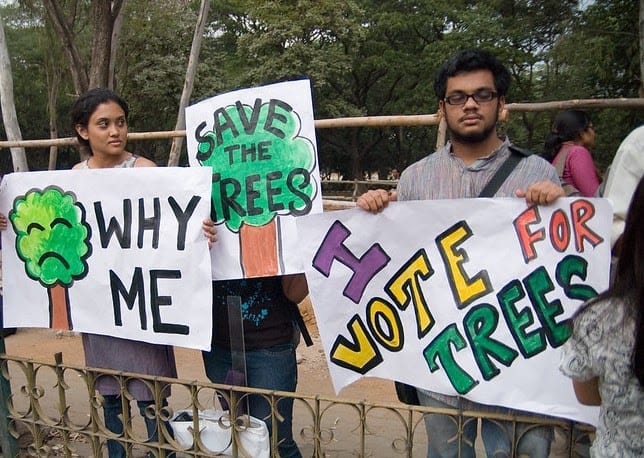
During the height of the anti-CAA movement in Bengaluru, which set a record of witnessing 82 protests in a single month, the Karnataka High Court had ruled that the action of the police, which prohibited the assembly of persons in the city on the pretext of curbing the anti-CAA protests, was unconstitutional.
The High Court also held that the ‘right to protest’ is a basic feature of democracy, which forms the basic structure of our Constitution. And the legislature cannot take away this right from the Constitution even through a Constitutional amendment.
Unfortunately, the Court in the public interest litigation, which led to this law, did not take these points into account, and did not test the law on the basis of these fundamental rights.
The only way forward to secure and expand the space for democratic activism in Bengaluru’s streets appears to be through the courts. The courts must be urged to strictly test the effects of this law on the basis of the fundamental freedoms protected under our Constitution. And the Courts should also, as the guardians of our Constitution, ensure that the right to protest is adequately protected and interpreted in such a way that it is practical, meaningful, and effective.