The Lokayukta Court has reserved its orders for 4th October regarding a complaint filed by T J Abraham against the consortium of NICE (Nandi Infrastructure Corridor Enterprise) and various ministers and bureaucrats.
Abraham has alleged various irregularities in the execution of Bangalore Mysore Infrastructure Corrdiror (BMIC) project. Allegations of a massive ‘land grab’ and financial fraud with the connivance of ministers, bureaucrats and NICE, form the core of his petition. Abraham, a businessman in his mid-forties, is the President of Karnataka Anti-Graft and Environmental Forum. The main petition runs to 147 pages. One annexure alone runs to 3,368 pages.
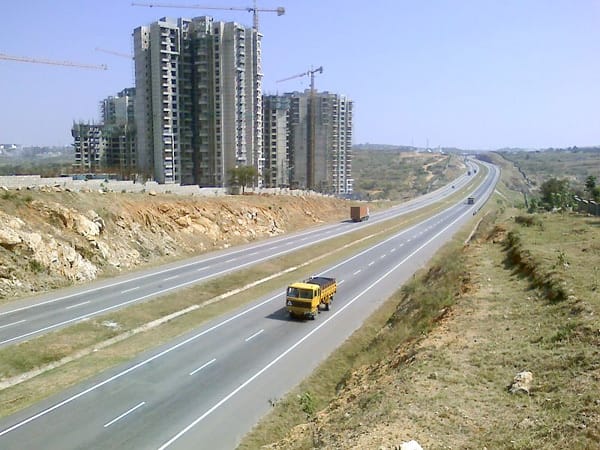
The peripheral link road part of the project. This tolled expressway now connects Hosur Road to Tumkur Road going all around the western fringes of the city, through Bannerghatta Road, Kanakapura Road, Mysore Road and Magadi Road. The BDA is said to have abandoned plans for the western segment of it’s own Peripheral Ring Road for Bengaluru because of this link road build by NICE. Pic: Wikimedia Commons.
In his complaint, he has accused 102 people of fraud including ex-chief ministers of all three major parties in Karnataka: B S Yeddyurappa, H D Devegowda, S M Krishna, Dharam Singh along with 57 IAS officers. Abraham has also alleged the involvement of ICICI Bank’s ex-chairman N Vaghul and former Advocate – General Ashok Haranahalli and most importantly, NICE Managing Director Ashok Kheny.
The allegations date back to 20th February, 1995 when a Memorandum of Understanding(MOU) was initially mooted between Government of Karnataka and then Government of the state of Massachusetts along with NICE consortium: Kalyani Group of Pune, Vanasse Hangen Brustlin (VHB) Inc of the USA, and SAB international Ltd. of the USA.
Abraham alleges that in 2002, the state government allowed NICE to assign its rights to Nandi Economic Corridor Enterprises Ltd (NECEL), adding the fourth party to the consortium. He alleges that GOK (Government of Karnataka) passed on the project to them, without questioning NICE’s claim of their managerial, financial or technical expertise.
Major allegations
(1) Increase in extent of lands in the Frame Work Agreement (2)Subsequent increase of government lands at minimum lease rent contrary to agreed conditions (3) Alignment shift of Peripheral Road, Link Road & Township No.1 brought in after 1998, but list gets circulated in 1997 itself. (4) KIADB enters into agreement with NICE on 14/10/1998, and incorporates fraudulent land list/details to the schedule (5) Fraud in obtaining/claiming stamp duty exemption for the toll road and also increasing the private lands by deceit. (6) Creation of sale of land at interchanges on toll road to facilitate financial closure for NECEL and to grab an additional extent of around 1,200 acres of private lands for mortgaging with ICICI Bank to raise funds: (7) Construction of bituminous road instead of concrete road and collection of tolls ‘illegally’ and (8) Preparation of Oiutline Development Plan (ODP) for 1,67,000 acres instead of 20,193 acres – ODP prepared by NICE and stamped by government as if prepared by latter.
Financial capacity
The document submitted states that the consortium was allowed to function without verifying their financial capacity. The cost of expressway consisting main expressway, peripheral road and elevated link road was proposed to be around Rs.1583.76 crores. The complainant also states that the consortium was asked to invest Rs.522 crores so that a debt of Rs.1063.65 crores could be raised. Instead, NICE mortgaged the land with ICICI Bank and raised Rs.150 crore as loan, says Abraham.
He says that KIADB too facilitated NICE by executing a sale deed prematurely. This allowed NICE to mortgage the land to ICICI bank for funds. With this amount the NICE deposited Rs 10 crore to KIADB, a requisite. He mentions that then ICICI Bank Chairman, N Vaghul was on the board of Nandi Economic Corridor Enterprises Ltd (NECEL).
Land requirements
The records also show that the land required for roads was 5,119 acres and 20,092 acres for the seven townships. The townships were allowed as this would fetch NICE the returns on the investment on expressway. According to the complainant, finance department in its report stated that four townships would yield adequate rate of returns but government approved five townships.
However, the land required for these five townships was 13,194 acres, and the total land requirement of the entire project was frozen to a total of 18,313 acres (G.O. No.PWD 32 CSR95, dated 20.11.1995). But later the land requirement for roads was increased from 5,119 acres to 6,999 acres and the total land required for the project became 20,193 acres. But Abraham notes that the approval of the 20,193 acres of land (Government Order of 27-03-1997) was not included in the Framework Agreement.
The complaint suggests enormous misappropriation by subsequent state governments and bureaucrats and that Bangalore-Mysore Infrastructure Corridor Planning Authority (BMICPA) was formed for a massive ‘land grab’. BMICPA has authority over the land, alongside of the expressway, one km from both the sides. Kheny is a member of BMICPA and decisions could favour, NICE. This irregularity could be as high as 1.67 lakh acres of land between Bangalore and Mysore, alleges Abraham.
In the hearing in the Lokayukta court on 17th September, Abraham said, not a single kilometre of the ‘concrete road’ of Bangalore Mysore Expressway is built, as per the framework. He claims, "It was a myth created about Bangalore to Mysore expressway by NICE. In reality it is a Bangalore to Bangalore project exercised for land grabbing."
Judge Sudhindra Rao, noting that he had not yet read the full details of the complaint, observed that there was no clear demarcation for the townships and the boundaries for the 20,193 acres was not earmarked. But, the numbers 20,193 had already become a brand, he said, referring to the irony.
In 2006, the Supreme Court had ordered that the acquisition of 20,193 acres of land be continued. Referring to this at the Lokayukta hearing, Abraham said, "Some of the important facts were not submitted to the court for this decision."⊕
Toll is increasing heavily on the NICE Road. Toll from PES College to Kengeri was 35 rupees 2 years back is now 48 rupees. Question is on what basis are they increasing the tolls and does it not have any Government Pre Approval?
I am tired of seeing news about such incidents. What I would really look forward to would be news items about the conviction of such persons and also the news that such transactions were annulled and a fine was levied.
I know that the media only reports news, so it is actually the judicial system that can give some hope to the common man.
Waiting to hear the end of this story!