Life in a Darshini

Most of us walk quickly into the Bangalore eateries that are called “Darshini”, order our food, and take it with hardly a glance at the person who is serving it. But that person often has a keen sense of observation, and may know you very well!

Meet H Veeranna (30), who has now been working at “Park View”, a Darshini at J P Nagar III Phase (Mini Forest) for eight years out of the thirteen that this eatery has been in existence. He is certainly one of the reasons why this bustling eatery is thriving; he, and his colleagues, always deliver service with a smile, no matter how rushed it is.
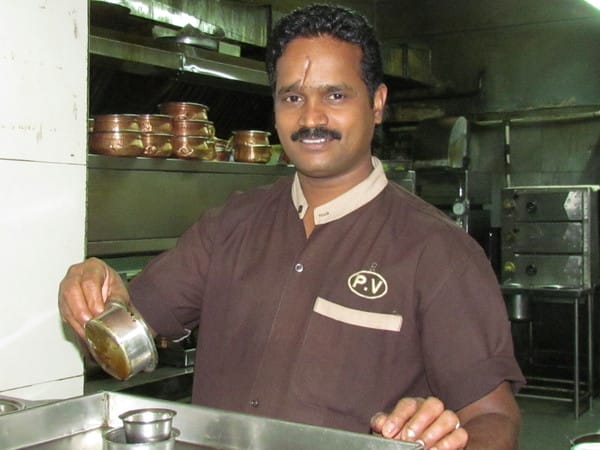
H Veeranna, who works in Park View Darshini, J P Nagar III Phase. Pic: Deepa Mohan

Veeranna belongs to Kundapur, and came to Bangalore to make a living. “I am lucky and happy to be here,” he says with a smile. He lives with the other members of the staff in accommodation provided by the owner P N Narasimha Murthy, at Marenahalli. He is able to save enough to send some money home every month to his mother and two sisters, back home. “I work both here, and our other location (Bangalore Tiffany’s near Brigade Millenium)”, he remarks.

His duties are mainly to oversee the cooking and packing of catered meals to various IT companies, ”We send out about 700 meals a day,” he says proudly, indicating to the huge stainless steel tiffin carriers that are used. He is also in charge of the coffee and tea section, and it’s a delight to be served by him! All the regulars know him well, and he knows each one of them. He remembers to never give me coffee with sugar! “I am so lucky and happy to have such nice customers,” smiles Veeranna, and I smile too, at the implied compliment!

Leave a Reply

Your email address will not be published. Required fields are marked *

Similar Story

Safety still out of reach: Everyday struggles of women with disabilities

Women with disabilities face increased risks in public and private spaces because of consent violations, unsafe surroundings and neglect.

Every morning, Samidha Dhumatkar travels from her home in Mumbai’s western suburbs to Churchgate, where she works as a telephone operator at a university campus. Her journey involves taking a rickshaw, boarding a train, and walking to her workplace, similar to thousands of other Mumbaikars who commute daily. However, as a person with a visual disability, Samidha’s commute is fraught with threats to her safety. In their book, Why Loiter? Women and Risk on Mumbai Streets, writers Shilpa Phadke, Sameera Khan, and Shilpa Ranade, argue that spaces are not neutral. Moreover, they are not designed equally. “Across geography and time,…

Similar Story

India’s stray dog debate puts the nation’s conscience on trial

Street dogs spark a national test — will India choose compassion or fear as law, humanity and coexistence come under strain?

At the heart of a nation’s character lies how it treats its most vulnerable. Today, India finds its soul stretched on a rack, its conscience torn between compassion and conflict, its legal pillars wobbling under the weight of a single, heartbreaking issue: the fate of its street dogs. What began as a Supreme Court suo moto hearing on August 11th has morphed into a national referendum on empathy, duty, and coexistence, exposing a deep, painful schism. Two sides Caregivers and animal lovers: They follow Animal Birth Control (ABC) and Catch-Neuter-Vaccinate-Return (CNVR). Their goal is to reduce dog populations and rabies…