Charity begins at home

Residents at Ajmera Green Acres go on a newspaper collection drive once every two months and sell the papers to raise money for charity.

About two years ago, we came up with a simple idea of collecting old newspapers from the apartments in this community, and sell them to the local kabadiwala. The money thus collected would be donated to local orphanages and old-age homes. Many residents, some as young as three, formed an army of enthusiastic volunteers that went around door to door collecting old newspapers.
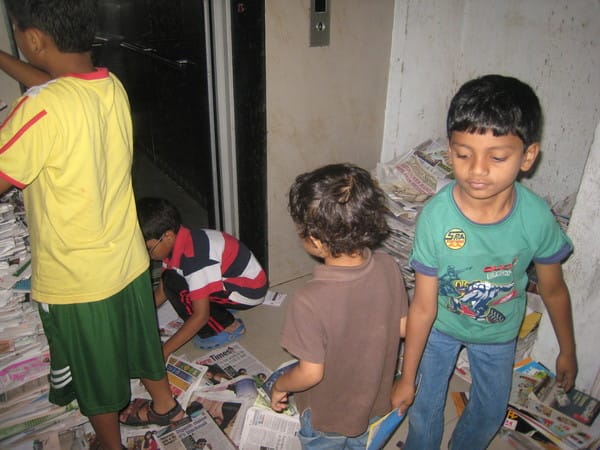
Young volunteers at work. Pic: Shree Rekha

With this initiative we have raised Rs 1,02,000 in the last two years and we have been able to help 13 local charity institutions, which includes schools, orphanages and old-age homes.

Once the charity organisation has been identified for donation, we went a step further to visit them, meet the students or the senior citizens, and find out what their current requirement is.

Principal of Twinklers Public School, an orphanage school, in JP Nagar told them, “Most often people think a school needs textbooks and notebooks. But our trust already provides those for the children. What we need is help with infrastructure.”

The money from that round of newspaper collection was then used to buy them a 2000 litre water tank.

This quarterly activity has seen tremendous support from the residents, especially the children, who happily spend their Sunday morning ringing doorbells and carrying bundles of newspaper. Tabassum, a six year old volunteer was heard to remark that this was one activity she really looked forward to.

We hope more and more communities will take inspiration from this story and start similar initiatives to contribute to welfare of their neighbourhood.

This whole initiative was inspired by, Divyadeepa Trust, Mysore.

Leave a Reply

Your email address will not be published. Required fields are marked *

Similar Story

The wild in the city: What citizen scientists tell us about Bengaluru’s biodiversity

Spatial and temporal biodiversity patterns, as observed by citizen scientists in the city during 2016-2025, were studied at a datajam in December 2025.

Imagine you’re out on a morning walk, phone in hand, when you spot a butterfly you’ve never seen before. You snap a photo, log it into a citizen science app, and voila! You’ve just contributed to crucial biodiversity monitoring. This isn’t just a hobby; it’s part of a global movement where ordinary people collect, record, and sometimes analyse data about plants, animals, and ecosystems. Citizen science stretches the reach of ecological research. Every observation adds to unique longitudinal datasets that reveal phenology — periodic events in the life cycle of a species — along with species distribution shifts and population…

Similar Story

Air quality management is a governance problem, not just an environmental one

Despite massive funding, Indian cities face weak governance, poor data, and limited capacity, as air pollution continues to worsen.

Indian cities are struggling to breathe. Air pollution is a year-round governance challenge. In 2024, 35 of the 50 most polluted cities globally were in India, with PM2.5 concentrations above 66.4 μg/m3. This is at least 13 times the World Health Organization (WHO) guidelines and at least 1.6 times the National Ambient Air Quality Standards (NAAQS) in India. Citizens continue to bear the brunt of worsening air quality, and urban local governments (ULGs) are at the forefront of the problem, being primarily accountable for their citizens' first mile. While they do have a role to play in addressing this threat,…