Reptiles are not always scary

They don't wink, their tails can detach themselves but they are quite useful to have around. Some interesting nuggets on lizards for you.

As you walk about in Bengaluru, you might often pass several reptiles without seeing them. Though it is not common to see snakes, they are sometimes sighted, and strike terror into our hearts usually, even if they are non-poisonous.
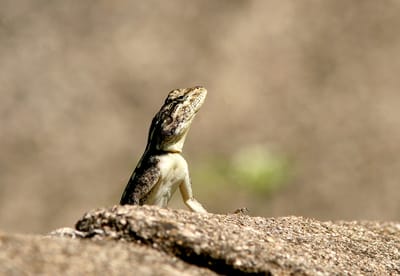
Pic: Deepa mohan

But apart from the snakes, lizards are a kind of reptile that we see very often, and which are very helpful in keeping the insect population down. The House Gecko or the lizard in the house, that we don’t like to see at all, actually eats cockroaches and other insects. Some of the other reptiles we see are the Garden Lizard and the Chameleon that changes colours is quite a sight.

All lizards are cold-blooded and need to sun themselves regularly to keep their body temperature up. Some of them, like the House Gecko, can detach their tails to run away from predators. Lizards also have pads on their feet that help them adhere to even difficult surfaces; that’s why we often see lizards on walls and ceilings.

One of the lizards we see often, out in the open areas, is the Peninsular Rock Agama, pictured above.

The male Agama develops a bright colouring during the breeding season, so that it is easily visible to the more dull-coloured female. However, the minus of this is that it is also more visible to birds and other animals that might prey on it. Agamas, too, normally scuttle away as soon as we approach them….and very often, they are so camouflaged on the rocks that one can easily miss them.

So the next time you pass a patch of mud or a large rock, look carefully…and you might see a fellow-resident of this city, looking back at you with an unwinking stare.

Comments:

  1. Deepa Mohan says:

    I find that knowing more about the creatures around us lessens the irrational fears we often have about them.

Leave a Reply

Your email address will not be published. Required fields are marked *

Similar Story

Reviving the Cooum: Need for innovation, enforcement and shared responsibility

An analysis reveals how this Chennai river is affected by sewage dumping, encroachment of buffer zones and unchecked urban growth.

The Cooum River, once a sacred river that shaped the history of Madras, has now become a sad sign of urban degradation. For the millions of residents in Chennai, it has transformed into a malodorous, polluted, and stagnant channel, burdened with solid waste accumulation and extensive encroachments along its banks. During a recent datajam organised by Oorvani Foundation and OpenCity, we used Geographical Information System (GIS) datasets and population analytics to investigate the underlying causes contributing to this crisis. The results show that rapid urbanisation, inadequate provision of essential civic infrastructure, and the absence of coherent policy frameworks, along with…

Similar Story

Pallikaranai at a crossroads: Expert warns of irreversible damage to Chennai’s last great marshland

In an interview, naturalist Deepak V says the government must publish ecological maps marking wetlands and waterbodies to boost public awareness.

The Pallikaranai Marshland, one of Chennai’s last remaining natural wetlands, has long been a site of ecological tension. Its designation as a Ramsar site brought national and international recognition, along with renewed expectations for strong conservation measures. Yet the marshland continues to face intense pressure from urban development, infrastructure projects and real estate expansion.  Recently, Arappor Iyakkam, an anti-corruption organisation, alleged that state agencies illegally cleared environmental and construction approvals for a large high-value housing project within the Ramsar boundary. As the matter unfolds, it reveals how regulatory gaps and political inaction make the marsh vulnerable. Meanwhile, residents of Tansi…