Trees outside my window

View from one’s window can be educational. Did you know for instance what we commonly call Ashoka tree is actually not Ashoka?

Nature is sometimes only as far away as one’s window! Here’s the view from an apartment balcony:
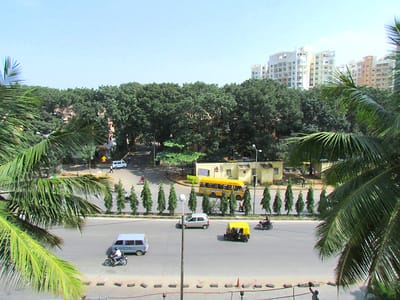
I can see four kinds of trees. Pic: Deepa Mohan

One can see the roads and transport and one can also see four different types of trees in the picture.

Framing the photograph at right and left, are some of the most common trees in India, the coconut palm. What a wonderful tree it is, with every part of it being useful to us…the palm fronds used for thatches, brooms and pandals for auspicious occasions; the coconuts being useful as one of the few drinks that cannot be adulterated, and is very nutritious; the trunk being used for both wood and boats!

On the median in the road are what are called Mast trees….they grow tall and straight like masts, and are often useful in breaking the force of the wind. They are often called Ashoka, too, but it is "Faux Ashoka", since the real Ashoka trees (you can see them at Lalbagh) are spreading trees with flowers and fruit.

Across the road, next to the small Traffic Police Station is a Jungli Badam tree. It is from this tree that our Badam (almonds) trees have been cultivated. This tree, too, has the same fruits…but they are likely to be much more bitter. This tree was planted after the Rain Tree on that spot was cut down for road-widening…and already gives welcome shade, with its broad leaves and spreading canopy.

Behind the Jungli Badam are a row of beautiful Mahogany trees, which are often planted as an avenue tree in our city. The Mahogany is known for its hard, termite-resistant wood, used in making furniture.

It’s surprising how an urban scene can give us so much of information about trees! We have many kinds of trees in our city, and Lalbagh has many kinds of trees brought from all around the world, too. Trees, and the life they support, are fascinating to know about!

Comments:

  1. Deepa Mohan says:

    This first post is dedicated to my Nature guru…Karthik 🙂

Leave a Reply

Your email address will not be published. Required fields are marked *

Similar Story

Inside Chennai’s AQI: Why hyperlocal monitoring of air quality is crucial

Official data masks Chennai's toxic air. Citizen Matters travelled with the IITM team to map variations in air quality. Watch the video to know more.

Across cities, official Air Quality Index (AQI) readings often overlook local hotspots. Chennai has eight Continuous Ambient Air Quality Monitoring Stations (CAAQMS) that function 24/7 throughout the year. But this isn’t enough to map particulate matter. Air changes every few metres, as researchers from the Indian Institute of Technology-Madras tell us. Seasonal variation, construction, vehicular movement, and proximity to industries also change the air we breathe, In 2022, over 17 lakh people died in India due to air pollution (PM 2.5), according to a Lancet study. With better hyper-local air data and public awareness, citizens and policymakers can target pollution…

Similar Story

Mumbaikars are fighting for their mangroves. Here’s how you can join them

Mumbai is about to face a monumental loss—its mangroves are being cut to build the coastal road. Citizens, however, have not given up the fight to save them.

​“What happens when we remove this natural infrastructure of the city? What happens if it floods? What happens if the air quality (index) goes really high?” asks Pooja Domadia, a member of the Save Mumbai Mangroves campaign. These are questions that many Mumbaikars have as work begins on the Versova-Bhayandar Coastal Road, which is set to affect 45,000 mangrove trees. In March this year, the Supreme Court dismissed a petition challenging the Bombay High Court order to greenlight the cutting of mangroves for the project. Is the SC decision a fatal blow to the movement? The BMC has already begun…