Puttenahalli Neighbourhood Lake Improvement Trust’s (PNLIT) "Nurturing Puttenahalli Lake back to its pristine glory" project cleared the December round (Round 4) of Mahindra Group’s "Spark the Rise" social campaign. The campaign is a platform to help put ideas into action to drive positive change in the nation and the winners are awarded grant money to put those ideas in to action.
"We’re delighted", says Usha Rajagopal, chairperson of PNLIT in a note to Citizen Matters.

Banner on display at the lake asking people to vote. Pic: Swaminathan O P.
After the fourth round victory, PNLIT is now eligible for Rs 4 lakh grant after submission of documentation to authenticate the trust’s work and making a presentation to the jury. The trust will also get a direct entry to the finale which will be held during March-April 2012, where three runners-up will get a grant of Rs 20 lakh each and the most voted project will get the grand prize of Rs 40 lakh.
Once a marshy garbage land because of neglect and rampant encroachment, the 13-acre Puttenahalli lake in JP Nagar, Bangalore, was revived over a period of a year in 2010 and early early 2011, by concerned citizens living around the lake. Usha Rajagopal, a writer and resident of nearby L&T South City apartments, Arathi Manay Yajaman of Brigade Millennium Apartments in JP Nagar along with others garnered support from local residents and spearheaded the rejuvenation process.
Encroachments were cleared, sewage inflow stopped and tens of trees were planted around the lake to return the lake to its former glory. The citizens’ initiative paid off.
A Puttenahalli Neighbourhood Lake Improvement Trust (PNLIT) was formed in 2010 to formalise the citizens’ efforts. Arathi Manay Yajman, a market researcher; Prasanna K Vynatheya, a software architect and O P Ramaswamy, a chartered engineer, all nearby residents contributed to the rejuvenation and became PNLIT’s earliest trustees.
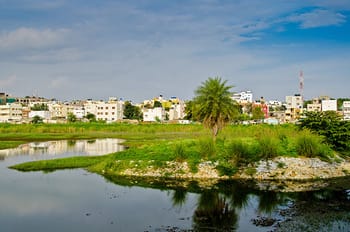
The rejuvenated lake shot in August 2011. Pic: Sudhir Singh. (puttenahallilake.in)
In another landmark development in 2011, PNLIT was given the charge by Bruhath Bengaluru Mahanagara Palike (BBMP) to oversee the maintenance of the lake for three years (from 2011-2014), the first instance of a citizens’ Trust being given such an opportunity.
The restoration has happened right in front of everyone in the area. "The garganeys have multiplied to over a 100", says Usha, proud of the fact that birds started to come back ever since the rejuvenation. Bird walks are also being held and schools have started sending children to the lake for visits.
In addition to their recognition from the Spark the Rise campaign, national television recently feature PNLIT’s work. Times Now’s Amazing Indians show chose PNLIT and the programme aired on the weekend of Jan 7th and 8th.

Students at a recent visit to the lake. Pic: Swaminathan O P.
"We are especially delighted that the children were also filmed for telecast. Their excitement at seeing the large number of birds in the lake was truly wonderful to watch!", said Arathi in her note to Citizen Matters.
In its action plan, PNLIT states that it wants to ensure that Puttenahalli Lake does not become extinct and make it a haven for bird life. The project also aims to Educate citizens on the importance of preserving natural resources as habitats for birds and other life. ⊕