Mark the ugly spot

You can mark garbage dump spots in your neighbourhood using Google Maps with VOSD's collaborative project, which tries to prove availability of garbage is the main influence of increasing stray dog population.

Improper waste management and burgeoning population of stray dogs could easily be considered as two ubiquitous problems plaguing the city of Bangalore. Animal welfare activists have for long claimed that the two might be correlated. They argue that availability of food in the form of garbage spurs the increase in population of stray dogs. Instead of culling the canines, BBMP should concentrate on implementing effective solid waste management system.
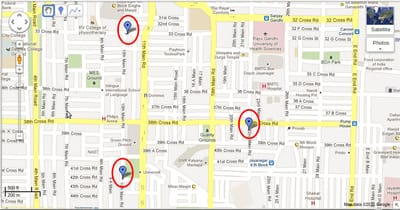
Three garbage dumps marked in a one kilometre radius in Jayanagar

‘Voice of Stray Dogs’ (VoSD), a pressure group, has launched a collaborative project, ‘X marks the spot’, where citizens can mark garbage dump spots in their neighbourhood using Google Maps. "We have always stressed that increasing urban stray dogs are a symptom and are not a disease themselves," says Rakesh Shukla, a city based entrepreneur and founder of VoSD. He adds that one of the factors influencing the population of stray dogs is availability of garbage as most dogs scavenge on the waste. "ABC is an effective way but to curtail the breeding population, you should control the food that is available," Shukla adds.
Google Maps is used to mark, with photographs, all areas in Bangalore which either have an open garbage dump area or open BBMP garbage segregation area. The former is marked in blue while the latter is marked in pink. The aim is to help citizens and BBMP monitor garbage collection.

The project, which has no fixed time-line and is open-ended, has 16 spots marked on the maps, however, no photographs have been uploaded yet. To participate, one has to send an email to info@strays.in indicating which area they want to mark. They will then be sent simple instructions on how to make change to the map. "We do this so that changes are not made randomly. We will review the inputs to verify if the details uploaded are correct," says Shukla.

Comments:

  1. Lakshminarayanan Krishnan says:

    Good to see this. Can you give the web address of ‘X marks the spot’ that we need to access in our browser to be able to mark dump sites in google maps? Can you explain the procedure how one would go about marking dump sites?

  2. Admin says:

    Please check the google map link. Details of how to add info here.

Leave a Reply

Your email address will not be published. Required fields are marked *

Similar Story

Explained: How Tele MANAS is shaping tele-mental healthcare in India

The Tele MANAS programme has supported over 28 lakh people across the country. Here's how it works and what it's achieved.

When a 30-year-old man from Karnataka felt overwhelmed by suicidal thoughts and a deep sense of hopelessness, he reached out to a government-run tele-counselling helpline. On the other end of the line was a trained counsellor from Tele MANAS, India’s national tele-mental health programme. The counsellor listened patiently, offered emotional support, and guided him to a nearby mental health hospital under the District Mental Health Programme (DMHP) for further care. In another case, a 17-year-old student, anxious about his upcoming exams, called the same helpline. He received practical advice, study tips, and daily motivation. Two years later, he called back…

Similar Story

,

When the Earth hurts, we hurt: Understanding eco-anxiety and eco-grief

In this video interview, experts discuss how climate change fuels eco-anxiety and explore how collective action can help us cope with and heal from its effects.

As the realities of climate change become increasingly evident, conversations around its psychological impact are more important than ever. In the first part of this series, we shared the experiences of individuals navigating eco/climate anxiety in their daily lives. In this second part, we speak with two experts, Cauviya and Samatha, to delve deeper into eco-anxiety and eco-grief and examine how environmental changes are influencing mental health across different social groups. Read more: Bengaluru’s street vendors are the first to be impacted by climate change: Lekha Adavi About the experts Cauviya Cauviya is an industrial/organisational psychologist who is trained in…