Citizens enrolling for Aadhaar (UID) card might be unwittingly sharing personal information with third party organisations in the near future. A key step of the enrollment process, is for data operators to ask for consent of the enrollees on whether they would like their personal information to be shared. However, operators are not always asking citizens for this consent. Citizen Matters observed this at the enrollment centre in Jakkasandra Government School, Koramangala.
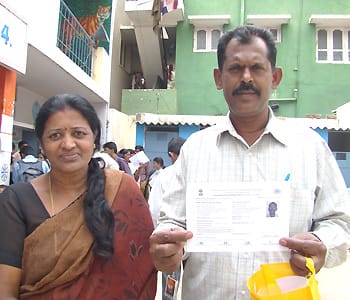 Srinivas Reddy and Anjali Devi, just after their enrolment.
Pic: Yogaraj S Mudalgi
Apoorva L J, Audit Manager for Wipro which is the enrollment agency, says that the particular centre is new and the inexperienced data operators might have missed out on the steps. He said that he was unaware that this was not being done. "Most centres do it now. We stress this when we visit all centres for inspection. We will rectify this at the Jakkasandra centre," he says.
Srinivas Reddy, 48, a police head constable living in the quarters nearby had been waiting in line along with his wife Anjali Devi from 9 30 in the morning. "Our photograph and biometric collection was completed by 1 pm and went smoothly. We heard that it will be of use in the future so we are getting in done," said Anjali Devi.
Margaret, 32, a resident of Jakkasandra, who had come for the enrollment said that she was unaware that there was a provision for sharing information, let alone asking for her consent. "I don’t really want any of my personal details to be shared with anyone," she said.
Following is an extract from the Resident Enrollment Manual found on the UID website:
Detailed Guidelines for Recording Demographic Data
Section 12. Information sharing Consent (mandatory):
1. Ask Resident‘s consent to whether it is alright with the resident if the information captured is shared with other organisations for the purpose of welfare services including financial services. Select appropriate circle to capture resident‘s response as -Yes/No
The manual states that consent taking is mandatory but remains ambiguous on the whether the organisations are government agencies or private companies. Mails to Nanadan Nilekani, Chairman of Unique Identification Authority of India (UIDAI) and Srikanth Nadhamuni, Head of Technology at UIDAI, did not elicit any response.
If you have enrolled in the last 48 hours and you did not consent for information sharing, you can still get the correction. Please visit the place where you were enrolled with the acknowledgement letter and you can request for a correction. Please note, corrections of details can be made only once.
⊕
good job yogaraj!