Residents of Koramangala have managed to get work on a new signal-free corridor project stopped, at least for the time being. Work for building grade separators had started at four junctions on Sarjapur road in June.
These are part of BDA’s signal-free corridor project from Agara to Sirsi Circle via Lalbagh road. BBMP had transferred the project to BDA last year due to paucity of funds.
Grade separators work had started at four junctions – Jakkasandra (flyover), Koramangala 80 feet road (underpass), Krupanidhi College (underpass) and St John’s hospital-Koramangala 100 feet road junction (flyover and underpass). Each grade separator is earmarked between Rs 20-29 cr, the total project cost is estimated to be around Rs 119 cr.
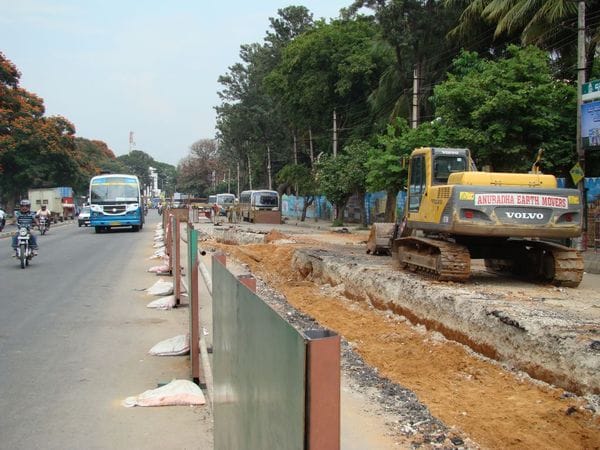
Work had already commenced along the stretch connecting Jakkasandra to the Koramangala 80 Feet Road intersection at 1st Block. Pic: Yogaraj Mudalgi.
Nagarjuna Construction Company (NCC) Ltd had bagged the contract for the four junctions.
Many residents of Koramangala took up the issue, with details of the project not being made public and BDA not consulting stakeholders before starting the project. There were specific objections on details of the project.
On September 23rd, Rajyasabha MP and ABIDe Convenor Rajeev Chandrasekhar (who is also a resident of Koramangala) called a meeting of senior officials and Koramangala 3rd block RWA representatives. BBMP Commissioner H Siddaiah, BDA Commissioner Bharat Lal Meena, ACP (Traffic) A M Saleem were among those who attended.
During the meeting alternatives were proposed to the project – residents said that traffic on Sarjapur road can be handled if Hosur road junctions were managed well. Meena and Siddaiah agreed to stop the ongoing work.
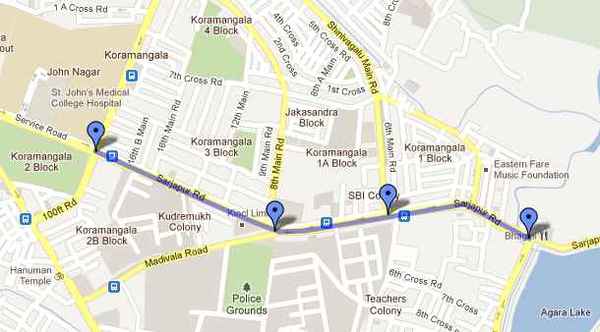
Map of the section between Jakkasandra (west) and St John’s Medical College & Hospital. The four underpass/flyover projects are marked. Map source: Google.
BDA PRO Dr K Puttaswamy says, “Work has been stopped for now, but we have not decided on further course of action. Commissioner will attend a meeting with Rajeev Chandrasekhar soon, to make a decision.”
During the meeting Chandrasekhar and residents had proposed alternate projects, first to build an elevated road connecting Silk Board flyover to Forum mall intersection, second, to deepen the underpass at Masjid junction for buses to travel smoothly.
Muralidhar Rao, member of the citizens’ group Koramangala Initiative (KI), says “The alternate solutions are what KI have proposed for long – as Silk Board junction was engineered poorly, many trucks are using Sarjapur road instead of Hosur road, leading to congestion here.” Rao is among those opposing the project.
Alternately, residents suggested at the meeting that if these works do not solve congestion on Sarjapur road, an elevated road can be built from Agara to Madiwala checkpost (intersection of Hosur road and Sarjapur road), while allowing vehicles to ply at grade level.
ACP (Traffic) Saleem says, “There is no written communication on work being stopped.BDA is yet to decide on the project. Elevated corridor would be better compared to underpasses, as width of elevated road would be more.”
The general consensus during the meeting was that grade separators were urgently needed in Madiwala checkpost and Total mall junctions along Hosur road, to handle interstate traffic flow.
Rao says, “The stoppage is only tentative. Since tenders have been awarded already, BDA can re-start the project later too.” ⊕