Why is management of waste so important in today’s time? Is segregation of waste worth the effort and time spent on it? When we pay taxes, why do we need to bother about waste management? If I manage my waste, is it going to help anyways? These are some of the questions answered by the Trash Trail organised by Daily Dump, Bangalore based service that helps you manage your waste.
We all gathered at Daily Dump office, in Indiranagar at 7.30 in the morning where we had a quick round of introduction of the ten participants and Poonam (founder of Daily Dump) and her two assistants Kamal and Kartik.
The first spot we visited on the trail, was the transit point in Indira Nagar. This is where the BBMP tipper autos transfer waste collected into the compactors. Here the staff separates out some high value stuff from the garbage which they sell at the local kabadiwalas.

Trash-trail Different plastics being sorted before being chipped. Pic: Trupti Godbole
The next point we visited was the second level kabadiwala, he is the one who buys scrap from the kabadiwalas (first level) who collect paper and plastic from households. Here all kinds of waste are accepted.
At the kabadiwala’s shop, it is further sorted out into different categories and then packed and loaded into trucks which carry it to Jolly Mohalla, K R Market, which is the wholesale scrap market. In Jolly Mohalla there are different shops dealing with different types of scrap. The labour there is highly skilled in sorting out waste of different types.
Second level Kabadiwala at Indira Nagar. Pic: Trupti Godbole
One of the shops there also has a shredder which shreds all kinds of plastic waste into bits which is then sent to Delhi for recycling. Each dealer has his own way of identifying different types of wastes. For example the dealer dealing with aluminium cans tests the quality of the metal using a basic magnet test. The stuff fetches a pricebased on the quality of the material. One of the persons working there told us “jo admi kaam nahi karta wo waste hai. baki kuch waste nahi hai”
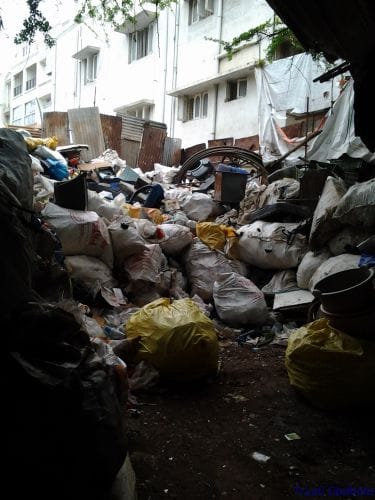
Next we went to the landfill in Hoskote. Being in a landfill was a very different experience all together. The stench emanating from the landfill hits you the moment you get off the bus. There is a huge sand bank behind which there are mounds and mounds of waste. Each day hundreds of trucks offload waste here which is then covered with a layer of sand. One has to be there to believe it.
After the landfill, we also visited a community who works with waste by sorting and segregating it and selling recyclable things to recycling units. They get truckloads of garbage from supermarkets and corporate offices. Here they have people segregating things into categories like tissues, plastics etc and then sell it to the recyclers in Nayandahalli.
After a refreshing lunch, we then visited Nayandahalli where plastic, metals etc are recycled. Here the machines shred plastics, convert it into pellets and then made into recycled products. The fumes emanating from these places was quite overwhelming and over powering. The visit to Nayandahalli was an eye opener of sorts. It was amazing to know how thermocol, plastics etc are recycled in such harmful conditions. It was very difficult just spend a few minutes and then to have to work there for long hours for years together is quite unimaginable.

Different plastics being sorted before being chipped. Pic: Trupti Godbole
It was indeed very enlightening to see and experience what happens to the garbage once it leaves households. Basically there are two sectors dealing the waste in the city, the formal and the informal sector. Under the formal sector, the municipal body of the city awards contracts to waste contractors who employ labour to collect waste from houses, shops, etc. There are sweepers with push carts, tipper autos and waste compactors that are used in collecting and trucking away the garbage to the landfill.
However, not much of material recovery happens in this system. The labourers sort out only some high value stuff and sell it to the local kabadiwalas. Rest of it is just trucked away to the landfill on the outskirts of the city. The landfill is a gruesome sight where all you see all around are mounds of waste layered with sand. The waste here just sits for ages and rots thereby polluting the air, soil and ground water.

Mounds of mixed waste at the landfill. Pic: Trupti Godbole
The informal sector dealing with waste is the section of small and big kabadiwalas who accept many types of waste for a price from the individuals and then sells it off to the wholesale scrap dealers in the city. Here the waste is aggregated and sold to recyclers. Also a set of people who stay close to the landfill receive waste from malls, corporate offices etc which is mixed waste. They sort out the waste and sell the recyclable stuff to the recyclers or to the wholesale scrap dealers.
This informal sector dealing with waste is quite important to the system since more more materials are recovered as compared to that in the formal sector. This way quite a lot of waste is being kept away from the landfills. However, the conditions in which the labourers work here need improvement in terms of light, ventilation, hygiene etc.
Lessons learnt from this trash trail can be expressed in a simple doable thing on part of households. Each households need to segregate their waste into wet and dry waste. Wet waste, which forms approx 60 % of the trash generated in each household, can be composted at source.
Dry recyclable waste generated in houses is approx 30% which needs to be handed over to recycling units via kabadiwalas. Paper items can even be handed over to institutions like ITC. This way we can reduce almost 90% of the trash from reaching the landfill. Only 10% of the rejects can then be handed over to the municipal garbage collection.
After coming back from the trash trail, I was physically and mentally quite exhausted. But the need to spread the message further to more and more people to segregate and manage waste has strengthened even more.
⊕
Thanks for sharing this. Helps understand better the waste segregation drive in my apartment in LB Shastri .
hope you convince others in your apartments to take responsibility of their waste and manage it effectively.