At any time of the day, you will see more people than birds at our Puttenahalli Lake. There are the brisk morning or evening walkers, strollers, people who use the track as a short cut to go from or to Puttenahalli, the time pass guys who sit singly or in a group at the gazebo, two wheelers, though their number is reducing gradually.
Well, we are constantly standing in their path and sending them back. That’s what I did today with a motorbike rider and a cyclist – much to the startled horror of three students from Kumaran School who had volunteered their time as “gardeners.”
This is a new initiative of PNLIT – to make residents feel the pride of ownership in the lake, we invite them to take a little time off over the weekend to do a spot of deweeding, planting, etc. at the lake.
Yesterday, three adults and two children came along. The adults piled the weeds in little heaps while the children aged six and three had fun spotting butterflies and collecting bottle caps. Indeed, they had so much fun, that Aditi and Mahiti coerced their mother to come today as well.

Young volunteers. Pic: Usha Rajagopalan.
I spent more time chasing the two wheelers, instructing the gardener, sweeper and security than pluck weeds myself. It made Aditi, the six year old tell her mother, “Amma, we came to help Usha aunty and she’s making us work like servants while she talks to people!”
She was right about the talking part. I do tend to talk a great deal every time I go to the lake.
Like Coleridge’s Ancient Mariner, I stop total strangers and engage them in a conversation. I ask them where they are from, whether they know that this lake is maintained by a citizens’ group (us, PNLIT), if they would like to help us, if they can tell their neighbours about Puttenahalli Lake. I stop bicyclists and motor bikes, tick them off for riding on the walking track and send them back. Trespassers who cut through the fence get a similar treatment.
With all this talking, my fluency with languages is increasing. Today, though, I did want to show Aditi that I am as capable of working with my hands as with wagging my tongue but then the three Kumaran students joined us as weekend volunteer gardeners.
Amith, Arvind and Sanjith are bright young boys in 10th standard, with a curious mind, articulate and full of questions – what are your plans to clean the water? What is this or that bird? What kinds of fish do you have in the lake? What is the depth of the water? Why do you have a date palm on the island? Why have you planted this kind of tree (Thespesia) below the electricity line? What other kinds of trees have you planted? How many? We’d like to bring all our classmates to the lake. What work can they do? How can we raise money for the lake?
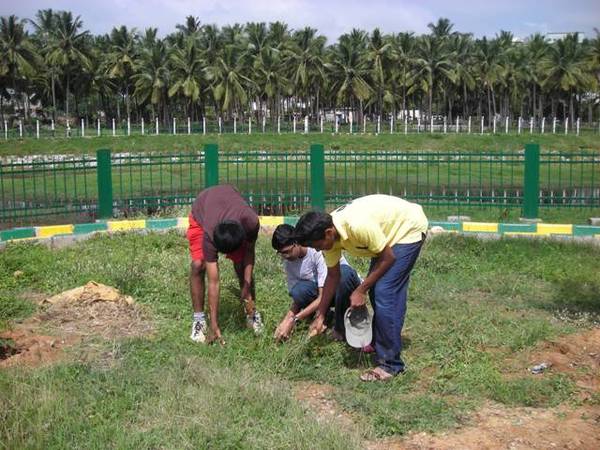
Young volunteers. Pic: Usha Rajagopalan.
The answer for each of their questions is enough for an article in Puttenahalli Post. I will not ramble now except to say that their words will linger in my mind for a very long time. For, while leaving, Arvind commented, “I always blamed the government for everything. Today I understood that I can also make a difference.” Indeed, you can, Arvind. Anyone can make a difference to society. Anyone can, in the words of Gandhiji, “Be the change you want to see in the world.” Good luck! ⊕
What a wonderful and inclusive way of protecting ‘common property’ without being possessive. That seems the difference between ‘sense of Ownership’ and ‘sense
of Trusteeship’. Congratulations.