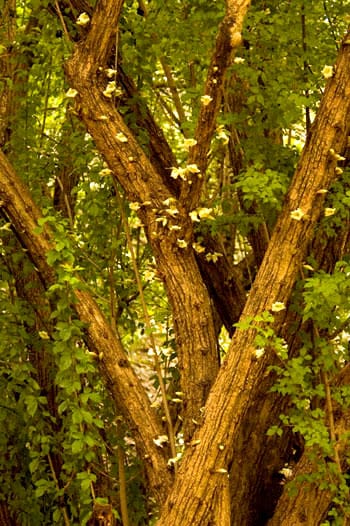
Flowering trees of Lalbagh

Lalbagh today probably has the most diversified collection of trees and plants of any botanical garden in the world.

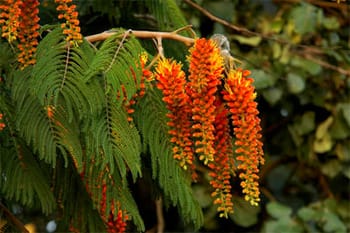
Colville’s Glory is one of the many picture perfect trees in Lalbagh. The tree is named after Sir Charles Colville who was Army Commander-in-chief in Bombay from 1819 to 1825 and subsequently Governor of Mauritius from 1828 to 1834.
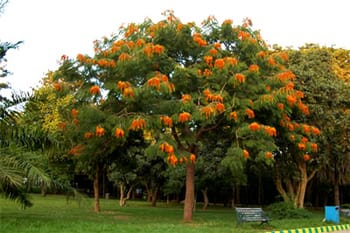
Colville's Glory tree, Lalbagh, Bengalooru Colville’s Glory tree Pic: MS.

DSC_6494 Colville's Glory Flowers, lalbagh, Bengaluru Colville’s Glory flowers. Pic: MS.

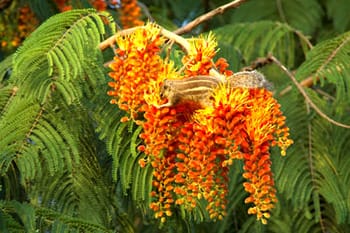
DSC_6539 Colville's Glory Squirrel on flowers, Lalbagh, BengaloreSquirrel on flowers of Colville’s Glory. Pic: MS.

Bojer, an Austrian Botanist, first found a single cultivated tree in 1824 in Madagascar when he mounted a specimen collecting expedition from Mauritius. Further, he described, in 1829, the flamboyant (Delonix regia or Gulmohur) which also he found in Madagascar.

Eight of the ten known species of Baobabs also come from Madagascar. It was from Mauritius that Colville’s Glory and the Gulmohar were disseminated worldwide, including India. (Source: Vijay Thiruvadi.)

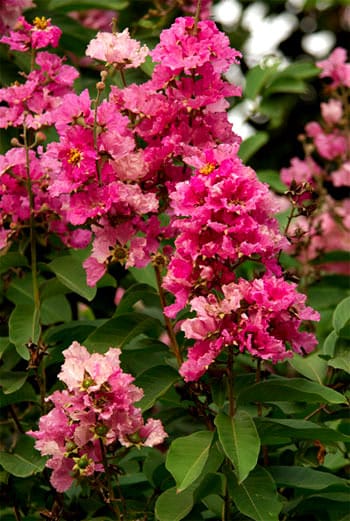
Jarul (Pride of India) is named after Magnus Lagerstroem, a Swedish merchant who funneled specimens from the East to Linnaeus in Europe. This tree is found across the Indian subcontinent in the Western Ghats, Bengal, Bangladesh, Assam, Myanmar and Sri Lanka. (Source: Vijay Thiruvadi.)
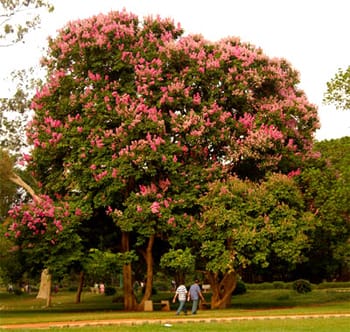
Jarul (Pride of India) Tree, Lalbagh, Bengalooru The Pride of India Pic: MS.

Jarul (Pride of India) Tree flowers, Lalbagh, BangalorePride of India’s Flowers. Pic: MS.

A few more flowering trees: the Brownea tree, and the Candle tree.

Brownea tree
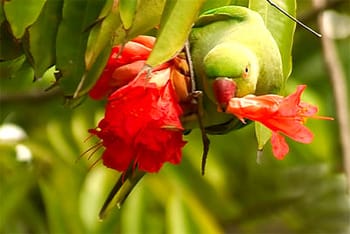
Parakeet feeding on the Brownea tree’s flower, Lalbagh, BengaluruParakeet feeding on the Brownea tree’s flower. (Pic: Mahesh Srinivas)

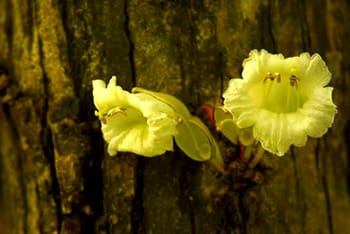
Candle Tree
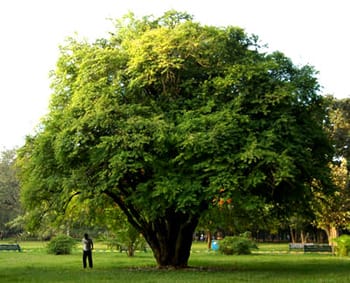
Candle Tree, Lalbagh, BangaloreCandle tree (Pic: MS)

Candle tree flowers, Lalbagh, BengalooruCandle Tree flowers. Pic: MS.

Candle tree branches, Lalbagh, BengaluruCandle Tree branches. Pic: MS.

Comments:

  1. Siri Srinivas says:

    Nice pictures!

Leave a Reply

Your email address will not be published. Required fields are marked *

Similar Story

The wild in the city: What citizen scientists tell us about Bengaluru’s biodiversity

Spatial and temporal biodiversity patterns, as observed by citizen scientists in the city during 2016-2025, were studied at a datajam in December 2025.

Imagine you’re out on a morning walk, phone in hand, when you spot a butterfly you’ve never seen before. You snap a photo, log it into a citizen science app, and voila! You’ve just contributed to crucial biodiversity monitoring. This isn’t just a hobby; it’s part of a global movement where ordinary people collect, record, and sometimes analyse data about plants, animals, and ecosystems. Citizen science stretches the reach of ecological research. Every observation adds to unique longitudinal datasets that reveal phenology — periodic events in the life cycle of a species — along with species distribution shifts and population…

Similar Story

Air quality management is a governance problem, not just an environmental one

Despite massive funding, Indian cities face weak governance, poor data, and limited capacity, as air pollution continues to worsen.

Indian cities are struggling to breathe. Air pollution is a year-round governance challenge. In 2024, 35 of the 50 most polluted cities globally were in India, with PM2.5 concentrations above 66.4 μg/m3. This is at least 13 times the World Health Organization (WHO) guidelines and at least 1.6 times the National Ambient Air Quality Standards (NAAQS) in India. Citizens continue to bear the brunt of worsening air quality, and urban local governments (ULGs) are at the forefront of the problem, being primarily accountable for their citizens' first mile. While they do have a role to play in addressing this threat,…