Bengaluru can now kick ball on Astroturf

Bengaluru has become only the third city in the country to get an Astroturf for football.

Bangalore footballers are going to be a happy lot soon. The International Federation of Association Football (FIFA) has honoured the Karnataka State Football Association (KSFA) with an Astroturf.

City’s football stadium in Ashok Nagar, is only one of three cities in India with astroturf surfaces, the other two being Kolkata and Mumbai. Those surfaces were also funded by FIFA.

"FIFA has recognised KSFA’s contribution towards football," says Amjad Khan, Deputy General Secretary of the KSFA and a former coach at the international level. "We have to make good use of the Astroturf and maintain it well, now that we have it," he adds
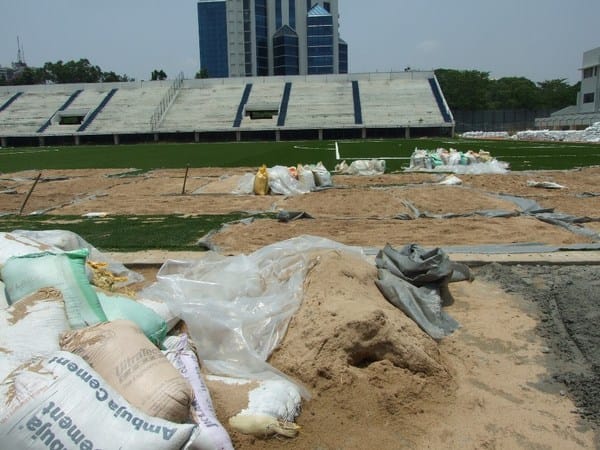
Race to finish the pending work. Pic: Maitri Vasudev

Astroturf is a preferred surface worldwide because it is far more durable than natural surfaces. This helps especially for tournaments with several weeks of continuous matches. It also requires minimum watering.

The inauguration of the Astroturf surface, which was supposed to take place on May 7, is now postponed to the end of May due to untimely rains, says the KSFA. Kushal Das, Secretary of the All India Football Federation, is scheduled to cut the ribbon, followed by an exhibition match by football veterans.

Khan notes that credit for bringing Bangalore an Astroturf surface goes to A R Khaleel, President of the KSFA. Khaleel’s position as the Chairman of Finance of AIFF also helped, he says. In another two months time, through his efforts, a Football Academy with a Rs.4 crore budget will also be launched, in all probability by Chief Minister B S Yedayurappa.

KSFA has won the Santosh Trophy – the topmost tournament of the country – four times and produced four runners up as well. Along with this, it has secured the top place in the under-19 three times and under-16 twice. Several champions have made it to the Olympics in London, Helsinki and Melbourne.


Leave a Reply

Your email address will not be published. Required fields are marked *

Similar Story

Safety still out of reach: Everyday struggles of women with disabilities

Women with disabilities face increased risks in public and private spaces because of consent violations, unsafe surroundings and neglect.

Every morning, Samidha Dhumatkar travels from her home in Mumbai’s western suburbs to Churchgate, where she works as a telephone operator at a university campus. Her journey involves taking a rickshaw, boarding a train, and walking to her workplace, similar to thousands of other Mumbaikars who commute daily. However, as a person with a visual disability, Samidha’s commute is fraught with threats to her safety. In their book, Why Loiter? Women and Risk on Mumbai Streets, writers Shilpa Phadke, Sameera Khan, and Shilpa Ranade, argue that spaces are not neutral. Moreover, they are not designed equally. “Across geography and time,…

Similar Story

India’s stray dog debate puts the nation’s conscience on trial

Street dogs spark a national test — will India choose compassion or fear as law, humanity and coexistence come under strain?

At the heart of a nation’s character lies how it treats its most vulnerable. Today, India finds its soul stretched on a rack, its conscience torn between compassion and conflict, its legal pillars wobbling under the weight of a single, heartbreaking issue: the fate of its street dogs. What began as a Supreme Court suo moto hearing on August 11th has morphed into a national referendum on empathy, duty, and coexistence, exposing a deep, painful schism. Two sides Caregivers and animal lovers: They follow Animal Birth Control (ABC) and Catch-Neuter-Vaccinate-Return (CNVR). Their goal is to reduce dog populations and rabies…