Spotted at Lalbagh

During a birding trip to Lalbagh, Ramesha spots a large number of Cormorants, besides Pelicans, Cattle Egret, Common Coot, Purple Water Hen and more.

The second Sunday bird watch at Lalbagh with BNG birders was a new experience. Of course every visit has something new. New topics, information, friends, lot more…

It was very interesting to see little children so actively involved, interested in knowing and understanding about birds. How do we observe birds, animals behaviors, their calls, types of nests and which trees, flower they visit etc. How often do the birds visit here or how many reside permanently. There is no end if we go deep in observation. We saw them and keep on clicking our camera.

And the Lalbagh small lake never disappoints us. Many water birds can be found. The highlight was the large number of Cormorants. Beside this, Pelicans, Cattle Egret, Common Coot, Purple Water Hen and many more can be found. There are two advantages to Lalbagh – get a very good walk and observe birds. 

Lalbagh is the heaven for birds and a university for bird watchers. The large number of people and children who joined the bird watching walk shows the growing awareness towards nature.
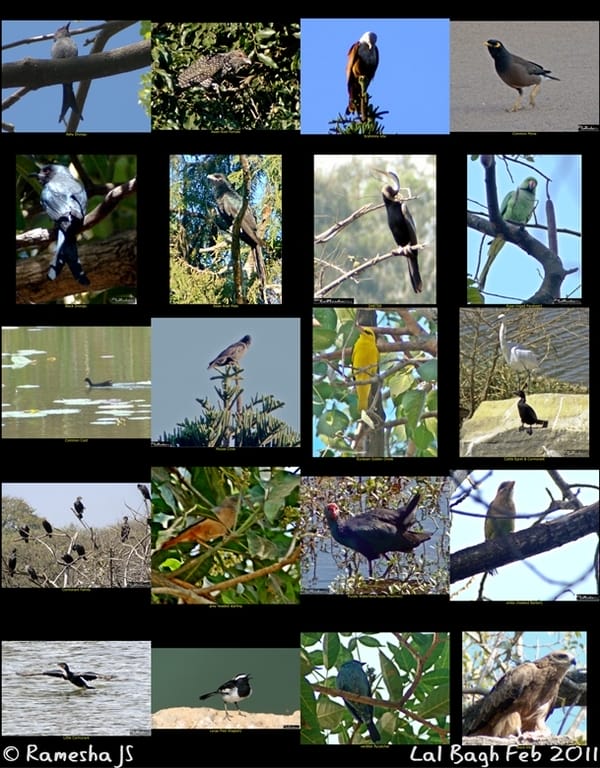
Birds observation list.

* Common Myna
* Pigeon
* Verditer flycatcher
* Eurasian Golden Oriole
* Grey headed starling
* Black Drongo
* Ashy Drongo
* Rose ringed Parakeet
* Black Kite
* Brahminy Kite
* Little Cormorant
* Greater Cormorant
* Darter
* Asian Koel Male
* Asian Koel Female
* Large Pied Wagtail
* House Crow
* Purple Water hen(Purple Moorhen)
* Cattle Egret
* White cheeked Barbet
* Common Coot

Comments:

  1. Deepa Mohan says:

    Nice article! By the way, the official name of the birdwatching group is “Bird Watchers’ Field Club”…I just found that out!

    Enjoyed the photos very much 🙂

  2. Sneha says:

    Excellent Article, the photos are too good, nice to see different varieties of birds

  3. rekha says:

    Very good article. all photos are eye catching. wana see many more articles from you. keep up the good work. best wishes are with you.

  4. Deepa Mohan says:

    Those of you who read this…please email Yeshoda, Ramesha’s wife, and tell him your good memories of him, please. He lives on in our hearts, as a good friend.

Leave a Reply

Your email address will not be published. Required fields are marked *

Similar Story

Where are the flamingos? How Metro construction is devastating Chennai’s Pallikaranai Marsh   

In a report, environmentalists warn marsh blockages increase flood risk for South Chennai and call for urgent measures to avert ecological damage.

On a regular day in May, the calls of migratory waders and other shorebirds foraging in sprawling mudflats fill the air in the southern reaches of Chennai. May is the dry season for the Pallikaranai Marsh, when water levels naturally recede, exposing the critical feeding and breeding grounds that attract hundreds of bird species to this globally recognised urban wetland. But this year is different. The mudflats are gone. In their place is a stagnant expanse of water. This unusual water level during the dry season is not due to early rains. Indiscriminate construction within the marsh is blocking the…

Similar Story

CIDCO’s new flamingo study raises questions on Navi Mumbai airport safety, wetland future

The Bombay Natural History Society had earlier pointed out that protecting wetlands and ensuring aviation safety should go hand in hand.

The City and Industrial Development Corporation of Maharashtra (CIDCO)'s decision to appoint Australian aviation consultancy Avisure to study bird movement around the Navi Mumbai International Airport has raised fresh questions about the future of Navi Mumbai's wetlands. The agency has cited the ongoing study as grounds to defer legal protection for DPS Flamingo Lake, arguing that no irreversible decision should be taken until the assessment of bird-related aviation risks is complete. But bird movement around the airport is not being studied for the first time. Findings of BNHS More than a decade ago, the Bombay Natural History Society (BNHS) was…