Most of us Bangaloreans consume eggs, whether as fried eggs or in cakes. But did you know where the egg on your plate comes from? From a factory or a farm?
India is among the top five poultry producers in the world today; we did about 45 billion eggs in 2009, from 200 million caged hens. Life for the hen in an industrial poultry farm is inhuman, to put it mildly. Treated as mere egg-producing machines, these hens get less than an A4 sheet of space to live their entire lives; are fed with steroids in order to make them ‘meatier’, de-beaked painfully without anaesthetics; even electric-shocked into laying more to beat production records. Most of them are allowed to live only upto 18 months before being culled for meat.
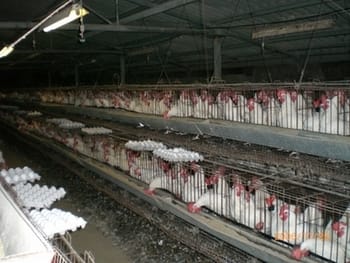
Chickens are housed in cramped cages with barely any space to move. Pic Courtesy: Wikimedia Commons.
Seventy-five per cent of all Indian eggs are produced the industrial way, and land up on the plates of 25% of people, all of whom live in cities (rural India only consumes 5% of the eggs it produces). Going vegan in order to boycott this cruel industry is definitely one option, albeit not a very popular or practical one. Pushing for humane methods of industrial production through legislation is perhaps the only scalable long-term solution. Animal rights activists and organisations like Humanity Society International (HSI) are actively working on presenting a draft of the ‘Prevention of Cruelty to Animals (Egg-laying hens) rule’ for a Central Government legislation.
Is there a more humane alternative we could support in the meantime without giving up meat and eggs altogether? Taking a cue from our own erstwhile backyard poultry practices, cage free farming, free range and organic eggs are alternative options that are gaining momentum; practices not without their flaws, but a positive step towards less cruelty.
The free-rangers
Keggs, Gurgaon-based poultry breeders since 1972, practice cage free farming by housing their hens in stress-free sanitary conditions on litter and offering them access to plentiful sunshine. Tan-coloured shells, bright yellowish orange yolks and firm albumen distinguish their eggs, available in upmarket stores. In Bangalore, these eggs are available at all Spencer’s outlets, More outlets and Thom’s bakery. The eggs are supplied from their processing centre in Gurgaon, New Delhi. The sales manager at Hosur says they supply just enough to satisfy demand coming from the few retail outlets in the city.

Keggs produces eggs by housing hens in sress-free sanitary conditions. Pic: Aarti Mohan.
Surprisingly, though the state government has no specific programme to promote free range farming, their own breeding facilities emulate it: at the eight to nine hens per roomy shed hatchery at the University of Agricultural Sciences (UAS) campus in Hebbal, the coloured-birds run around happily, get cosy corners to lay eggs, a centrally-suspended feed machine, clean drinking water, and an attendant constantly watching out for them.
Organic eggs
Organic eggs refer to those coming from hens fed on a wholly organic grain feed, containing zero pesticides, herbicides and chemical fertilisers. Keggs hens, for example, get fed on a rich diet of maize, soya, sunflower, limestone, vitamins and other organic plant products together with ample greens. "I get ragi wastage from the nearby mills. I also give them homemade Ayurvedic medicines when they fall sick", says Naushad Pasha, backyard poultry farmer from Kanakapura, in a telephone interview. Pasha sells all his produce while sitting in his farm – his chickens fetch him Rs 120/kg and eggs go at Rs 10 a piece, proof of the demand across economic groups for healthy poultry produce.
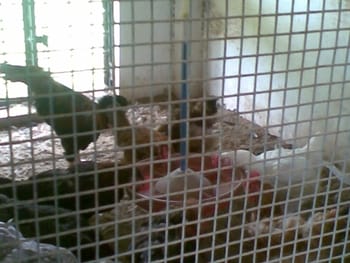
The hatchery at University of Agricultural Sciences in Hebbal is roomy. Pic: Aarti Mohan.
The Karnataka government breeding program provides healthy, disease-resistant varieties like Giriraja and Swarnadhara in a bid to promote ‘backyard livelihood’ options. The hundreds of rural farmers and village women who benefit from this program sell all their eggs in their local communities. Keggs is the only Indian enterprise that has scaled to offer these to urban consumers; their eggs for the health conscious come at a 40-50% premium over unbranded ones.
Organic or free range poultry products do come at a price. It is not feasible to house the hundreds of millions of hens in cage free conditions; there is neither enough land nor enough alternative poultry farms to support that. An increase in awareness to push legislation while consuming consciously could be a first step. So when you head out to the market the next time, think about buying eggs from hens that were treated humanely!
This post is a re-written excerpt from the article ‘Meri Jaan, Meri Jaan, Ande with Fundae’ that was published in the quarterly thematic edition Offbeat on food. The Alternative and Offbeat are online publications that seek to bring mainstream focus to social development issues in India.
⊕
Happy Hens, a poultry farm outside Bangalore, started by Manjunath Marappan (Ph:9900514195), supplies freerange eggs on bulk order.