The construction of a subway at the busy KR Market has been delayed by almost two years now. Local officials in the BBMP, BWSSB and the contractors carrying out the work, are passing the buck, blaming one another. Currently, work on the site has been held up due to a massive sewage pipe that needs to be removed.
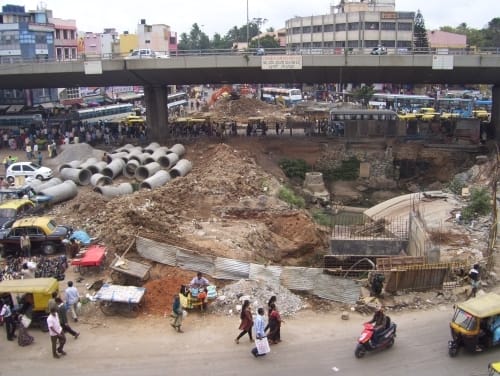
The subway construction near KR Market started way back in September 2006. Pic: Prabhu Mallikarjunan
The Rs 6 crores project started in September 2006 and was scheduled to be completed in January 2009. Seventeen months have passed since, without much progress. The project is a joint venture between Maruthi Constructions, based in Seshadripuram, and Malaysia Green Constructions.
Chief Contractor of Maruthi Constructions, Lakshmipathy Ramprakash says, "Owing to lack of co-operation from BBMP and BWSSB, the project has been delayed", adding that no action has been taken with regard to shifting the sewage pipe.
Another hurdle that has hit the project is also the backing out of one of the contractors Malaysia Green Constructions, says Ramprakash. "They did not have an office in Bangalore. They have cheated many people and we have filed a criminal case against them." Ramprakash claims.
However, BBMP denies any knowledge of this development. But the corporation’s Chief Engineer (Major Roads) T N Chikkarayappa does admit to the fact that the delay is due to shifting of the sewage pipe. "We’ve directed the BWSSB to complete as early as possible and it should be completed within next one month", he says.
BWSSB, on the other hand, says it will take another two months for them to remove the pipe. "We have been given approval to work only during night and we employ eight to ten workers, working between 10 pm and 4 am", says Abdul Nazir, BWSSB’s sewage and waste management engineer.
Started: September 2006
Scheduled to be completed: January 2009
Project Cost: Rs 6 crores
Contractors: Maruthi Constructions and Malaysia Green Constructions.
On visiting the site at about 10:30 pm on August 23rd and September 7th, there were no workers anywhere in sight. Nazir, on the other hand, continues to maintain that work is in progress. This massive pipe that is said to be delaying the project is of 900 mm width and 300 meters length.
With the BWSSB yet to shift the sewage pipe, Shyam Iliyas, a subcontractor at the site says they are yet to interconnect this new subway to the existing subway at KR Market, and insert concrete blocks towards Apsara Junction and near the BMTC bus stop. "We have laid the concrete blocks and covered one part of the subway so that vehicle movement can begin."
Delay in project affecting public
Now this new subway will serve pedestrians walking between Victoria Hospital, KR Market bus stand and Avenue Road.
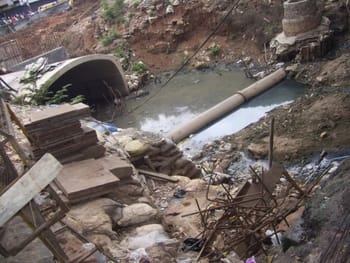
The sewage pipe that is yet to be shifted by BWSSB has delayed the subway construction. Pic: Prabhu Mallikarjunan
But currently, with dug-up roads and dumped pipelines, BMTC buses have difficulty in moving. There are six policemen directing traffic and pedestrians, and they have a hard time controlling the chaos.
Traders and shop-keepers have also been affected by the delay in completion. "Our business is affected as not many people come to the shops because of this pathetic condition and we have to pay bribe to the police on a daily basis despite our low earnings", says Suhail Ahmed, a street vendor.
A commuter says, "I used to frequent this place earlier for shopping, but I have reduced my visits due to the unhygienic condition."
The foul smell from the sewage water and recent rains has only added to the woes of the vendors, passengers, auto drivers and the general public.
BJP’s P Dhanraj, Corporator of Dharmaraya Swamy Temple ward (Ward 119) quoted the BWSSB saying they would complete the work within a month time. The entire subway work would be completed within two months time, he says. ⊕
Even a year after, not much progress is seen on this project. All we get to hear is one more obstacle. Look at the story done by another IIJNM student this year. http://thesoftcopy.in/city_subway.html