For many of the urban poor, education is a luxury. Even as many private schools become unaffordable in Bangalore, quality of government schools are not very impressive.
Children from the lower economic background, who attend schools (mostly government schools) are unable to learn much due to poor infrastructure and teaching methodologies. Many of them are scared of subjects like English, Science and Mathematics. One initiative which hopes to tackle this problem is the ‘Evening School Centre’ run by the volunteer group, AID (Association for India’s Development, Bangalore Chapter). These are centres found in slums and neighbourhoods populated by the lower economic strata, which has volunteers working with the children to ease the process of learning through enjoyable activities and interactive sessions.
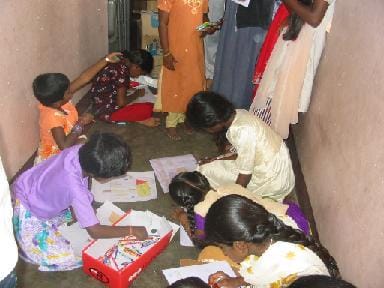
Volunteers teach at a slum tution centre (courtesy: AID India)
The Evening School in Appajappa Garden, a slum near Minerva Circle, Lalbagh Road, is one example. The first set of girls from the local community, who have passed PUC II year last year are serving as role models for the other children in that area. They had attended the night school centre classes and are now handling classes in other evening school centres.
These girls may not have scored a first class, but their feat is nonetheless admirable. Because, their success is not just a question of getting marks in their exams. They have done it against great odds – they have struggled with their environment, economic crises and family’s opposition.
Association for India’s Development, Bangalore chapter (http://bangalore.aidindia.org)
Sundharya’s father doesn’t go out to work and is sick most of the time. Her mother works as a domestic help and takes care of the whole family. Sundharya cannot really afford the tuition fees for higher classes. But, with some scholarship and help from individuals, she is continuing her education and finished PUC II year. Her home is a 10′ x 10′ room which houses a family of four.
Sridhar, earns his tution fee amount by washing cars in hotels. He gets up at 5:30 am, studies for a while, cycles to work at 7 am, comes back by 9 am in time for school. In the evenings, he attends night school. He has learn to speak in English on his own! He has completed his 10th std and currently is in PUC II year.
These children are really hard working; they are continuing their education overcoming tough challenges. For me, their "Just Pass" score means more than a 100% score by students who have better opportunities.
Hello Balaji
Can I get in touch with you ? I would like to discuss if I can volunteer for this.
Thanks
~rk
Sure, you may mail me to balaji.kutty AT gmail.com.