Temple of Karumariamman Amma amidst busy neighbourhood

Before the temple was built, there was an ant hill and a serpent, claim the residents of Someshwar Colony.

On the busy Ring Road in Kuvempu Nagar (BTM Layout) near the BTM bus terminus, unnoticed by many of us, there is a small temple, dedicated to Karumariamman Amma -a well known goddess in Thiruverkadu, Tamil Nadu, now is in midst of a busy neighbourhood.
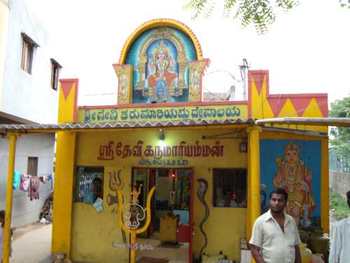
Temple dedicated to Karumariamman Amma. Pic: Chetan Boray.

Before the temple was built, there was an ant hill and a serpent, claim the residents of Someshwar Colony. Muniswamy, Ramchandra, Nagaraj and P Shanmugam, all residents of the area took the initiative of constructing the temple. It was completed in the year 1994.

Every year, a five-day Varamaha Lakshmi festival is celebrated with great fervour. The first day is Hasi Karaga, then the goddess is decorated in various Alankaras such as  Benne ( Butter ) Alankara, Arishina Alankara and so on, based on the wishes of the devotees.

On the final day, Huvina Alankara and Karaga are performed. The evening will see events such as konda (walking on fire), music and dance.  Funds are collected from the local MLA and the residents of the area for the Varamaha Lakshmi festival.

P Shanmugam who looks after the temple says, “Generally, people from Tamil Nadu come and have darshan but it is open to all.” The priest of the temple, Sekhar who has been serving there for the past 11 years says, “ I was born to serve (the goddess).” He is originally from Krishnagiri, Tamil Nadu, and he adds, “My family is a traditional purohit family”.

Even though the temple is in the midst of the busy world, Sekhar says a lot of people come for Amman’s blessings. Tuesdays and Fridays are considered auspicious days to visit the temple.   ⊕

Leave a Reply

Your email address will not be published. Required fields are marked *

Similar Story

Safety still out of reach: Everyday struggles of women with disabilities

Women with disabilities face increased risks in public and private spaces because of consent violations, unsafe surroundings and neglect.

Every morning, Samidha Dhumatkar travels from her home in Mumbai’s western suburbs to Churchgate, where she works as a telephone operator at a university campus. Her journey involves taking a rickshaw, boarding a train, and walking to her workplace, similar to thousands of other Mumbaikars who commute daily. However, as a person with a visual disability, Samidha’s commute is fraught with threats to her safety. In their book, Why Loiter? Women and Risk on Mumbai Streets, writers Shilpa Phadke, Sameera Khan, and Shilpa Ranade, argue that spaces are not neutral. Moreover, they are not designed equally. “Across geography and time,…

Similar Story

India’s stray dog debate puts the nation’s conscience on trial

Street dogs spark a national test — will India choose compassion or fear as law, humanity and coexistence come under strain?

At the heart of a nation’s character lies how it treats its most vulnerable. Today, India finds its soul stretched on a rack, its conscience torn between compassion and conflict, its legal pillars wobbling under the weight of a single, heartbreaking issue: the fate of its street dogs. What began as a Supreme Court suo moto hearing on August 11th has morphed into a national referendum on empathy, duty, and coexistence, exposing a deep, painful schism. Two sides Caregivers and animal lovers: They follow Animal Birth Control (ABC) and Catch-Neuter-Vaccinate-Return (CNVR). Their goal is to reduce dog populations and rabies…