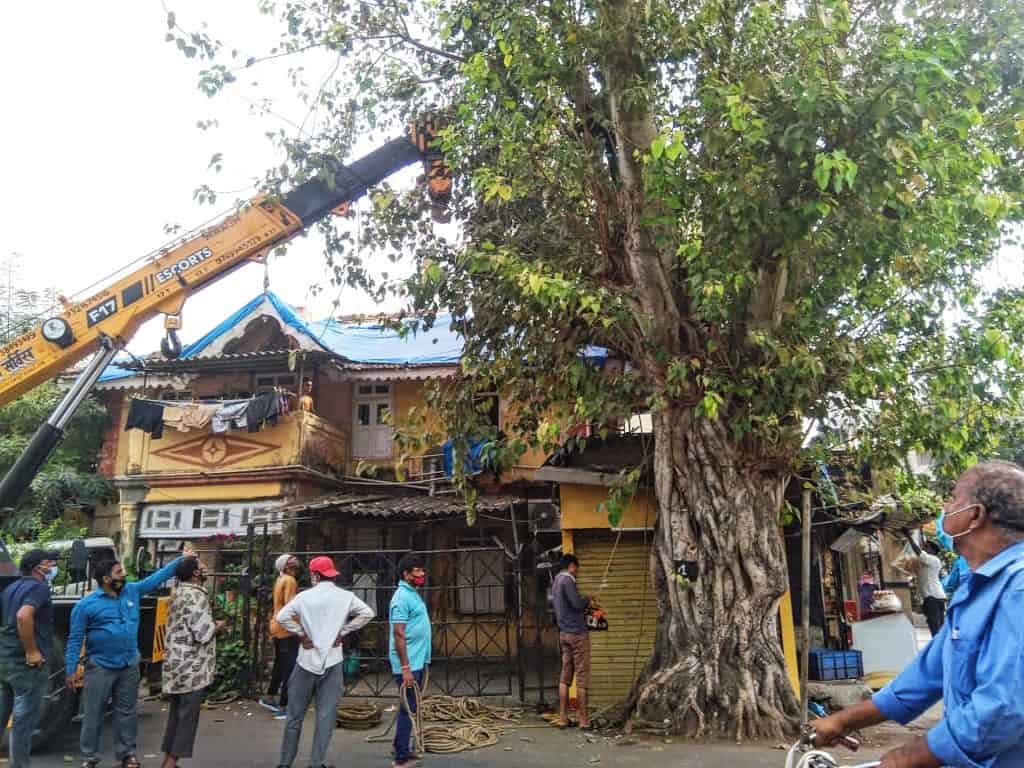
On January 22nd, a healthy and flourishing peepal tree, approximately 100 years old, was chopped at Azad Road in Vile Parle East. Junior Tree Officer of K East ward, Mr. Pradip Jadhav, arrived at the spot at 9:30 am** with his team to cut the tree.
At the sight of this, I asked the officials about permission they had been granted for the operation, and learnt that the notice was given four years ago in December 2017. The permission to cut, after objections, was given in November 2018.
Because of it’s outdatedness, in a constrained manner, I requested the officers to halt the operation and issue a fresh public notice, but to no avail. Instead, the assistant police officer (API) present, Gopal Bhosale, took offence at my ‘impoliteness’ since I was delaying the work. I was then violently shoved into a police van in a video that quickly went viral. Detained afterwards at the Vile Parle East Police Station, I was threatened with an FIR, which hasn’t materialised yet. With the help of environmentalists, I was released 3 hours later.
Meanwhile, the tree was razed to a stump.
Historical precedent
The tree’s stump stands in St. Francis Pakhady (or hamlet), an urban village by the train tracks.
In 2018, the BMC planned to widen VS Khandekar Marg, that adjoins Azad road, to make way for the sixth railway track between Borivali and Mumbai Central. For this, 12 of the 70-odd cottages and bungalows in Vile Parle gaothan would have to go.
The residents submitted their objections to the proposal, suggesting instead a one-way road to tackle the traffic without any demolition. The tree in question was highlighted, and the request to cut it was titled: ‘Removal of trees obstructing traffic at Azad road’. But the BMC’s own inspection convinced them that just trimming it would suffice.
Furthermore, in response to a PIL, the Bombay High Court in 2019 restrained the BMC from acquiring (and demolishing) any gaothan land or house without due process. If anything was to be done to the tree, the notice should have also been provided to the Heritage Conservation Committee** of the village, another aspect that was missed when the tree was cut.
Read more: Is concretisation killing trees in Mumbai?
What does the law say?
The BMC’s rash move was wrong not only environmentally, but also legally.
To begin with, the tree is over 50 years of age. This makes it a heritage tree, according to the Maharashtra (Urban Areas) Protection and Preservation of Trees Act, 1975. The state government last amended the Act on July 16, 2021, adding extra protective measures for heritage trees.
The Amendment states:
- The advertisement must mention it is a heritage tree.
- The age of the tree must be determined.
- The number of trees planted as compensation should be equal to the estimated age, and at least six feet high.
- The case should be referred to the Maharashtra State Tree Authority,
- The maximum penalty for illegally felling trees is increased from Rs 5,000 to Rs 1 lakh.
Because the permission to cut the tree was given in 2018, the MCGM conveniently neglected current requirements. Instead, the old permission necessitates planting only 2 trees as compensation. It also does not order the transplantation of the tree, as is customary when cutting them to widen roads.
It is a shame that a tree that stood tall for a century has been cut, and so brazenly. We have lost an entire ecosystem, alive with birds, insects, and other arboreal species flourishing on its branches and bark. As a citizen concerned with the environment, the events of the day are highly disappointing and go against the Maharashtra Government’s promises to conserve the environment and ensure climate justice. Such arbitrary and illegal actions of public officers are condemnable and cannot be permitted.
While the Mumbai Police regretted the incident, citizen activists should not be treated with force and intimidation.
For this reason, I have started a petition to ensure action against the officers responsible for ordering the illegal tree cutting. The remaining portion of the tree stump should be revived in a scientific manner, and honored with proper compensatory planting.
You can add your voice to the citizen-fueled mission here.
Corrigendum: Asterisked portions have been changed post publication to correct certain inadvertent factual errors. We apologise for the errors in the first published version.