In the early 70s, my visits to Delhi and Calcutta involved late night travels within the city. During my trips to Japan during 1985-95, my working hours were most unpredictable extending beyond midnight most days and I’d travel back to my hotel by myself. Recently between 1995 to 2009, my usual practice was to drive back home from e-city in the late hours. I am not sure whether cities was safer or I was just lucky.
Nevertheless we have to face cruel realities of today. I understand as young women you are raring to go and want to have the freedom to work at your chosen hours and build your careers. If one is worried all the time as to how one can reach home, I am sure it will be frustrating.
Years ago, we had fewer women in the work place. Though accepting women in work place was an issue then, it was perhaps easier for companies to ensure safety of women. With large number of women joining the workforce, it can be more challenging to account for all aspects. I believe we should collectively create a safety net around us.
Yes, the government has the responsibility of ensuring safety of citizens, and industry should take care of the safety of employees, particularly women both at work place and elsewhere. Public transport systems and security systems require a major thrust along with changes in attitude.
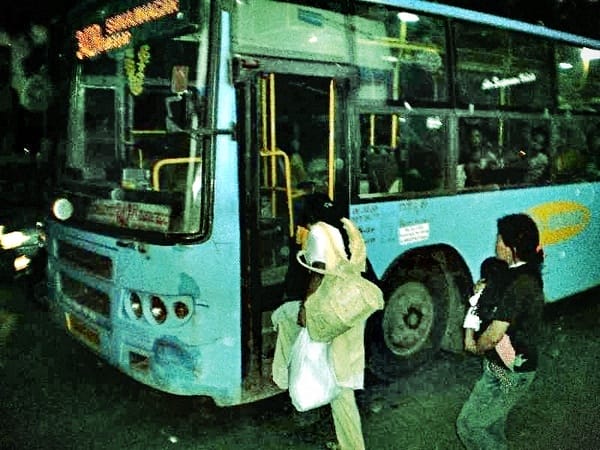
Public transport can make your commute safer. File pic.
While we will continue to urge the authorities to augment the personnel, systems and processes to make our lives safer, let us also look at ways to protect ourselves. Our reactions needs to match our environment; if there is any perceived threat, we are better off taking necessary precautions. We often assume we are insulated, nothing will happen to us and we can take care of ourselves. God forbid nothing should happen, but a bit of preparedness can avoid traumatic experiences faced by Nirbhayas/Pratibhas
Traveling alone in autos or unauthorised transport vehicles during late hours is a risk. Autos/ Tempo Travellers may save time and money but at what cost? Using unauthorised modes promotes violations of transport and safety laws; it impacts public transport services negatively, getting into a downward spiral which makes it even more ineffective.
Being alert and having a planned approach can help reduce impulsive and risky decisions to travel in unknown vehicles. Yes, such incidents disturb us, shake our confidence and create panic. We also tend to ask why is that I cannot do what I want? Why I am not allowed to do what I want even in such simple things like going out and finding safe transport. We tend to react angrily to some of the safety measures suggested. I share similar sentiments but unfortunately society has not just reached a point to guarantee a safe ecosystem. We need to tactfully manage the situation and take safety precautions.
Just an example: at Electronic City, we deploy the Central Industrial Security force (CISF) to ensure security for all of us working here in e-city. It doesn’t mean we are weak – it just shows we are proactive and prepared.
Let us accept that we are not in a ideal situation. Giving importance to personal safety can prevent ugly incidents.
Related Articles
Helplines and support for women
6 points for women to keep in mind, for them to be safe while going out
Bengaluru’s young working women living in fear
Why women stick to kambas in BMTC buses
Agree.
CISF? One of these days I’m certain I’ll see a report of some crimes committed by CISF personnel. Same as the police, army and others. And I also know of companies that send ‘security’ staff with women in cabs to protect them! For reasons best known to them, CEOs want a chalta hai culture everywhere along with their other friends in power. No process is followed. Be prepared – carry a gun. This is exactly why the American Constitution gives its citizens the right to bear arms and so does Cuba, Mexico, Switzerland,… Don’t expect a government run by criminals to be worried about your safety.
Well intentioned, but exactly the kind of thinking – “women need to be more careful” – that leads to the blame for rape being subtly thrust on the victim. It is very sad and extremely disappointing that a woman in a leadership role is conveying this. Being ‘careful’ and ‘taking necessary precautions’ are pretty much second nature to most women in India I believe, given the conditions out there in public spaces. What they need are not more such cautionary messages, which they receive enough of anyway, but full unrelenting support for their right to live life on their terms.
I agree with everything Gokul Janga said. If we’re suggesting women “look at ways to protect ourselves” then women have to stay away from all the men in their lives considering how 90% of reported rapes in India have been committed by someone the victim knew.
This is an old thread. I wonder why the author is getting shouted at. She merely suggested that women take care of their own security by staying alert.
Even a highly “advanced” nation like couldn’t prevent rapes and groping on this New Year’s Eve party.
India is actually the safest place in the world. Do you know the number of rapes in the US. It’s 150,000 in 2014. Their population is 250 million. We’re 1200 million. Reported rapes are 17,500 as per national crime statistics. It’s on their website. Please check yourself.
The writer is absolutely right in advising women to be alert all times. You may also advise them to carry pepper spray. It’s quite useful.
My example was of Germany.