The lady under the flyover

Ashok Kumar writes about a chance encounter with someone on the street, and realises that not everyone is motivated by money!

I was heading to office one afternoon, when I saw a woman under the flyover. Greasy stains on her clothes, hair all knotted and tangled, she was wandering the streets, talking to herself. Nobody cared about her; nobody heard her.
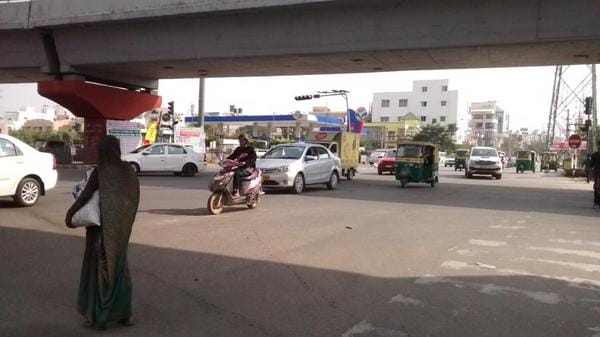
The lady waits to cross the road, bag in hand. Pic: Ashok Kumar S

I felt sympathetic towards the woman and I stopped by the flyover and went near her. I was trying to do the best thing that I could and I offered her Rs 100. She looked reluctant and declined my offering.

I tried to make her accept it by talking to her in Kannada and Telugu, but she didn’t seem like she understood either language. She said something in her own language which I could not understand. Hand gestures or signals did not convey much either.

Instead of money, I should probably offer her food. So I rushed to a sweet stall to fetch some eatables and juice for her. 

By then, she was sitting under the flyover, near one of the cemented pillars. She bowed her head and took a parcel of food from her polythene bag. And she began to eat her food. She seemed entirely unconcerned about the situation.

I offered the eatables to her while she was eating, and she declined my offer yet again. I was trying to tell her to save this food for later, but she was not convinced. All I could do was watch her silently for a few moments.

Of course, people around us looked at us with puzzlement. I had tried to do my best to help, but she did not care for the money or food I offered her.

It was then I realised that not everyone in the world is motivated by money. There are people who are happy with just what they have!

Leave a Reply

Your email address will not be published. Required fields are marked *

Similar Story

Safety still out of reach: Everyday struggles of women with disabilities

Women with disabilities face increased risks in public and private spaces because of consent violations, unsafe surroundings and neglect.

Every morning, Samidha Dhumatkar travels from her home in Mumbai’s western suburbs to Churchgate, where she works as a telephone operator at a university campus. Her journey involves taking a rickshaw, boarding a train, and walking to her workplace, similar to thousands of other Mumbaikars who commute daily. However, as a person with a visual disability, Samidha’s commute is fraught with threats to her safety. In their book, Why Loiter? Women and Risk on Mumbai Streets, writers Shilpa Phadke, Sameera Khan, and Shilpa Ranade, argue that spaces are not neutral. Moreover, they are not designed equally. “Across geography and time,…

Similar Story

India’s stray dog debate puts the nation’s conscience on trial

Street dogs spark a national test — will India choose compassion or fear as law, humanity and coexistence come under strain?

At the heart of a nation’s character lies how it treats its most vulnerable. Today, India finds its soul stretched on a rack, its conscience torn between compassion and conflict, its legal pillars wobbling under the weight of a single, heartbreaking issue: the fate of its street dogs. What began as a Supreme Court suo moto hearing on August 11th has morphed into a national referendum on empathy, duty, and coexistence, exposing a deep, painful schism. Two sides Caregivers and animal lovers: They follow Animal Birth Control (ABC) and Catch-Neuter-Vaccinate-Return (CNVR). Their goal is to reduce dog populations and rabies…