Recently, the citizens’ movement CfB (Citizens for Bengaluru) presented the Corporator #1 awards to the BBMP councillors who had attended the most ward committee meetings. If you are convinced that ward committee is an effective mechanism to engage with the government, this articles gives some pointers for you to get started.
Bengaluru’s governance is what it is due to decades of apathy and lack of active citizen participation. There are no instant fixes, but things can be improved if committed citizens come together and work on the ground with a clear action plan.
The good news is, there are many active citizens out there. If we channel our energies and use formal processes and forums like ward committees, we will see a remarkable transformation, one street at a time. This requires patience and perseverance the most.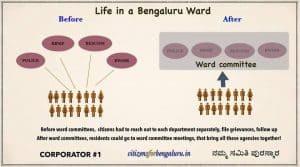 The motto is “slow and steady wins the race!”. Each ward has at least 50,000 people, now even if 100 people come together, it will be a start.
Here is a step-by-step guide for you to mobilise fellow citizens and actively engage with your ward committee, for better local governance.
Step 1: Form a group of citizens from your ward who are interested in engaging with your ward committee for the next six months. Find tips on creating such groups, towards the end of this article.
Step 2: Familiarise yourself with the concept of ward committees, find out who your ward committee members are, and organise discussion forums. Find the details of your ward committee members here. You can reach out to CfB for help, if needed.
Step 3: Engage with your corporator and ward committee members before the monthly ward committee meeting. Confirm the time and place of the meeting, and spread the word beforehand.
Step 4: Attend the ward committee meeting to raise issues. Ensure that the minutes of meeting are recorded and posted in the BBMP website. Spread information about the minutes in your local communities.
Step 5: Ensure the monthly meetings always begin with follow up of action items from the previous meeting. Get all responses from the corporator and officials recorded by the secretary of the ward committee.
Step 6: Keep local communities informed of the decisions made in ward committees. Invite them to join the next meeting.
Step 7: Use platforms like IChangeMyCity to better understand funds and projects in your ward. Also, push the ward office to display information on all ward-level projects, bills, beneficiaries, property tax collection, meeting notices etc, to make it accessible to all.
Step 8: A week before the ward committee meeting, give written requests to include specific items in the meeting agenda. Giving formal written requests is key, and someone in your group must take this responsibility. Ideally, the agenda is to be prepared by the ward committee secretary based on formal requests from citizens. Ad hoc meetings without clear agenda, action items or follow up won’t last too long.
Step 9: Organise ward committee awareness sessions in local schools, parks and residential areas. Invite the corporator, ward committee secretary and members to these sessions. People in your ward should know them.
Step 10: Set up social media spaces for your ward committee, and keep updating these with photos, videos, details of decisions made, challenges faced etc. This would get more people to follow and participate in your ward committee meetings.
If another group is already working on ward committees, join them instead of creating yet another forum; it is always a good idea to combine forces.
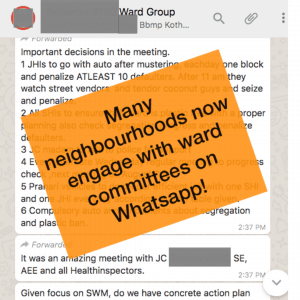
Use technology to build a strong local community that engages with the ward committee
Each ward has different characteristics and unique challenges, so do consider local factors while engaging. No group can sustain online, so make plans to meet in person routinely, perhaps a week before each ward committee meeting. This will help you prepare better for the meeting as well. Ensure that a significant number of residents attend meetings. If 50 people show up in ward committee meetings, it will send a strong message to the corporator, ward committee members and officers. |
Resources you can use:
- Ward committee details and meeting minutes, ward-level projects, finances and property tax collection in BBMP website: http://bbmp.gov.in/wardcommittee
- Contacts of ward committee members: http://wc.citizensforbengaluru.in/
- Ward maps: http://opencity.in/data/bbmp-wards
- Finances and projects of your ward, submitting and tracking grievances: http://ichangemycity.in
- Video on the powers of ward committees: https://www.youtube.com/watch?v=3IOtQ2yaU-0
- Presentation on ward committees: http://bit.ly/cfbwardcmte
- A comprehensive article on Bengaluru’s ward committees: https://citizenmatters.in/ward-committee-functioning-faq-december-2018-29430
Very valuable information and platform to track our representatives and officials accountability.