What’s crawly need not be creepy

The very word ‘Tarantula’ is something that strikes dread into most of our hearts. We’ve all heard the horror stories of ‘evil’ arachnnids delivering fatal bites.

However, though they may be deadly Tarantulas elsewhere, the ones we have nearby are generally more wary of us than we are of them, and do not bite until they are extremely disturbed.

Tarantulas comprise a group of very large and often hairy arachnids belonging to the Theraphosidae familyof spiders. Their large size and hairy appearance, combine to give most of us a dread of them. But they have some very interesting features!

Tarantulas do spin silk like other spiders do… but they do not have the kind of web that we often see. Instead, some of them, especially those which make homes in burrows, line their burrows with silk! Sometimes, to protect their babies, they even put up a “silk screen” in front of their holes.
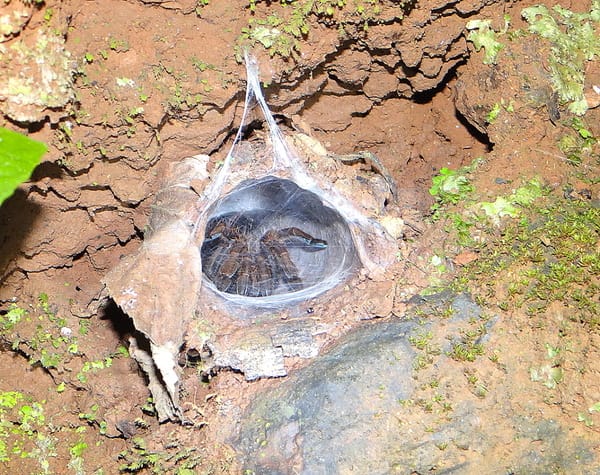
A tarantula under the silk-screen she has spun. Pic: Deepa Mohan

However, tarantulas themselves can be the prey for other insects. Here’s a video I took, as I once watched a Spider Wasp drag a Tarantula that she had stunned (you can still see it moving a little in the video), into a hole she made in the ground.

Such wasps then lay their eggs on the stunned spider, and when the larvae hatch later, they have fresh food. Another of the marvels of nature!

So, what’s crawly may not be creepy, if you get to know more about it… and the fear of the creature goes away, too!

Leave a Reply

Your email address will not be published. Required fields are marked *

Similar Story

From Kuruvimedu to Besant Avenue, how Chennai breathes unequally

Ahead of the art exhibition ‘Pugai Padam’, this photo essay captures the contrasting realities of air and the lived experiences of air pollution in Chennai.

The chimneys of the NTECL Vallur Thermal Power Station, billowing smoke, loom over Kuruvimedu in Ponneri, Thiruvallur near Chennai. Wedged between the plant and its sprawling 300-acre ash pond, the hamlet lies under a blanket of kari (coal) and sambal (ash), coating its narrow streets, colourful homes, and trees. Kuruvimedu is hard to find on Google maps, just as its namesake bird. The main road leading to this place is flanked by factories and industrial complexes, its surface riddled with potholes that make every journey dangerous for motorists.  Home to mangroves, networks of canals, and fields, Kuruvimedu once buzzed with…

Similar Story

Pallikaranai’s 1-km buffer zone sparks debate on housing rights, encroachment and ecology

On World Wetland Day, Chennai's Pallikaranai marsh shows how decades of state‑sanctioned encroachment leave residents and ecology at risk.

Across Pallikaranai marshland, migratory birds can be spotted, searching for forage and water. Yet the wetland they depend on has steadily depleted. As Chennai has grown in an amoeba-like manner, ebbing with the promise of ‘development,’ the marsh has borne the brunt. In the 1990s, the marsh covered 2,450 hectares, nearly 70% of its original size. Today, barely 500 hectares remain. In recent years, the marshland has often entered public discourse. In September 2025, Chennai Metropolitan Development Authority (CMDA), acting on an order from the southern bench of the National Green Tribunal, halted planning permission for development within the Pallikaranai…