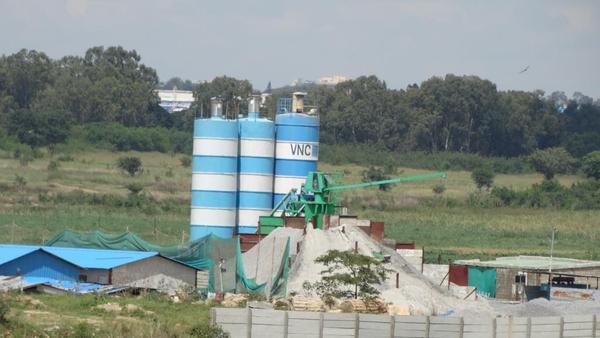
Massive SEZ coming up on the catchment area between Agara and Bellandur lake. File pic.
With the deadline only a week away for an eight-member Expert Committee to study Special Economic Zone (SEZ) project on Agara-Bellandur lake catchment area, the Committee has decided to submit an interim report on the project for the time being.
The Expert Committee was formed by the National Green Tribunal (NGT) as part of the litigation proceedings on the SEZ project by Mantri Tech Zone Pvt Ltd and another project by Core Mind Software and Services Ltd, on May 7th, 2015.
‘Yet to get details from BWSSB, KIADB’
While constituting the Committee, the NGT had stated that the Expert Committee should inspect the projects and submit a report to the Tribunal as well as the Ministry of Environment and Forest within three months. “The Committee while studying any adverse environmental and ecological impact of these projects on the lakes, also will suggest whether any part of the project is required to be demolished. If so, details there of along with reasons be provided,” the Tribunal had said.
Apart from studying the particular SEZ project, the NGT had also directed the Committee to inspect other areas in Bengaluru where various projects might have had an impact upon the waterbodies, particularly lakes.
However, the Committee has so far studied only Mantri and Core Mind projects and is yet to inspect other projects. Committee Convener IFS officer Vijaya Kumar told Citizen Mattersthat the Committee has so far studied only two projects in question and will submit an interim report on the same before the deadline.
“We are yet to inspect other such projects. We might continue our study on other projects and include the observation in final report,” he said.
On asked about the observations of the Committee, the Committee Convener said that they are yet to arrive at a conclusion. “We are yet to get details of the project from Karnataka Industrial Area Development Board (KIADB), BWSSB and other agencies. A clear picture can be drawn only after the information is corroborated. The Committee has convened two meetings till now and the third meeting will be convened on August 1st,” he said.
The Expert Committee comprises of:
- Advisor in the Ministry of Environment and Forest dealing with the subject of wetlands
- CEO of the Lake Development Authority
- Chief Town Planner of BBMP, Bangalore
- Chairman of SEAC
- Senior Scientist (Ecology) from the Indian Institute of Sciences, Bangalore
- Dr. Siddharth Kaul, former Advisor to MoEF
- A Senior Officer from the National Institute of Hydrology, Roorkee
Karnataka State Pollution Control Board Member Secretary Vijaya Kumar is the Convener of the Committee.
The projects by Mantri Techzone are facing an NGT litigation filed by Forward Foundation and Bangalore Environment Trust, and supported by resident welfare associations in the Koramangala – HSR Layout – Bellandur area.
Related Articles
Bengaluru SEZ exposé wins environment award for Citizen Matters scribe
No approval: BBMP orders Mantri SEZ to stop construction
Agara SEZ to multiply traffic on Sarjapur Road
How govt helps SEZ trump Bellandur lake
Not sure what can be done if builders use muscle power : http://www.deccanchronicle.com/150916/nation-current-affairs/article/bengaluru-builders-threaten-members-national-green-tribunal