A moth, not a hummingbird

If you happen to see Hummingbird Hawk Moth this winter, be assured that you have a lot of good luck on your plate!

A moth that looks like a tiny bird! India does not have Hummingbirds, those tiny creatures of the light and air that so delight those living or visiting abroad, especially the western coast of America. Our smallest birds are our Sunbirds and Flowerpeckers.

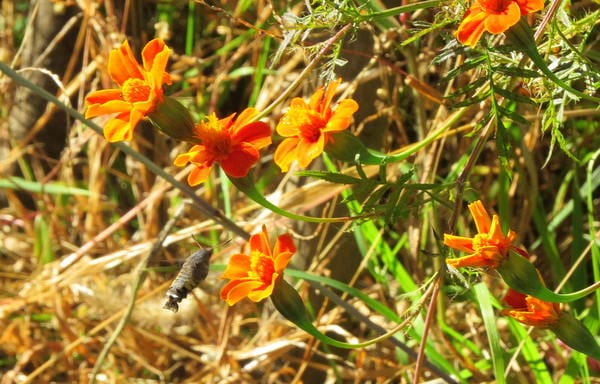
However, even in urban gardens, one may find oneself looking at something that seems remarkably like a Hummingbird, and yet seems different. In India, this probably means that one is looking at a Hummingbird Hawk Moth! The scientific name for this small creature is Macroglossum stellatarum. They belong to the family called “Sphingidae”.
Pic: Deepa Mohan

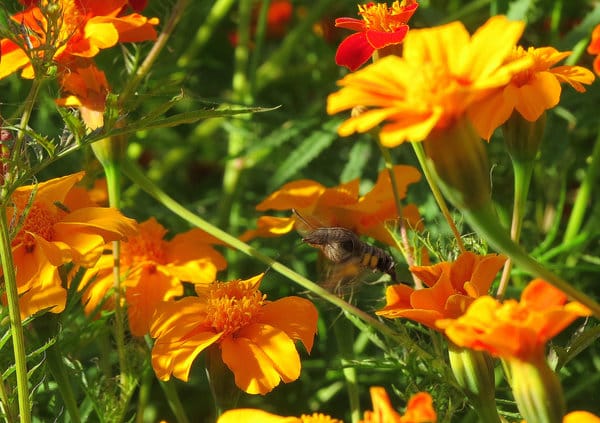
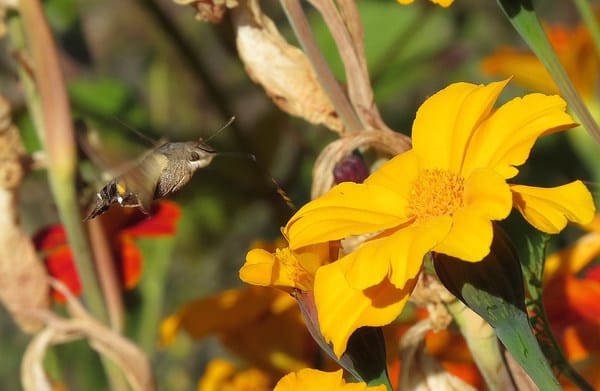
In our country, these moths can be found in the northern parts of the country during summer, and in the south, too, in winter. The moth’s long proboscis and its hovering behaviour, accompanied by an audible humming noise, make it look remarkably like a hummingbird while feeding on flowers.
Pic: Deepa Mohan

It flies during the day, especially in bright sunshine, but also at sunset and sunrise…, and even in the rain!

Pic: Deepa Mohan

Hummingbird hawk-moths have been seen as a lucky omen! The British forces saw them flying on D-Day during the Second World War, and took it to be a sign of victory, which eventually proved true.
Pic: Deepa Mohan

These moths are particularly fond of nectar-rich flowers and they can be seen feeding on flowers such as marigolds (which was where I took these photographs). Here is a short video I took, of this unusual moth that looks like a tiny bird: 

So…the next time, during these winter months, you hear a humming sound near the garden flowers…look closely and see if there is a Hummingbird Hawk Moth around to delight you!

Related Articles

Damsels dancing in nature!
Bangalore’s first eBirder meet
Finding the hidden birds in urban green spaces

Leave a Reply

Your email address will not be published. Required fields are marked *

Similar Story

Beyond the parks and gardens, Bengaluru’s ‘wasteland’ ecosystems call for protection

Open Natural Ecosystems in Bengaluru harbour rich biodiversity. Take a look at what they hold and what we risk losing to unchecked development.

When we discuss urban nature, we often forget about real natural habitats. In Bengaluru, widely called the Garden City, most talks about urban nature focus on landscaped parks, roadside trees, and manicured gardens; in other words, artificial ecosystems designed for looks and human comfort. As lay citizens, we usually notice only such nature as we see around our homes, workplaces or other areas we generally pass by. While these places do have some ecological value, they mostly support a few highly adaptable species. This has strong negative implications for native flora and fauna that depend on open scrublands, grasslands, rocky…

Similar Story

The wild in the city: What citizen scientists tell us about Bengaluru’s biodiversity

Spatial and temporal biodiversity patterns, as observed by citizen scientists in the city during 2016-2025, were studied at a datajam in December 2025.

Imagine you’re out on a morning walk, phone in hand, when you spot a butterfly you’ve never seen before. You snap a photo, log it into a citizen science app, and voila! You’ve just contributed to crucial biodiversity monitoring. This isn’t just a hobby; it’s part of a global movement where ordinary people collect, record, and sometimes analyse data about plants, animals, and ecosystems. Citizen science stretches the reach of ecological research. Every observation adds to unique longitudinal datasets that reveal phenology — periodic events in the life cycle of a species — along with species distribution shifts and population…