Green car rally for a cause

This unique car rally is organised to foster friendship between visually challenged people and other citizens.

"I took to street driving (just) a year ago, it was a moment of pride holding the trophy with my team" says an elated Rathiga B, winner of the ECO car category in the 6th Car Rally for the Blind 2012 held in June, in Bangalore. The rally is organised to foster friendship between visually challenged people and other citizens.
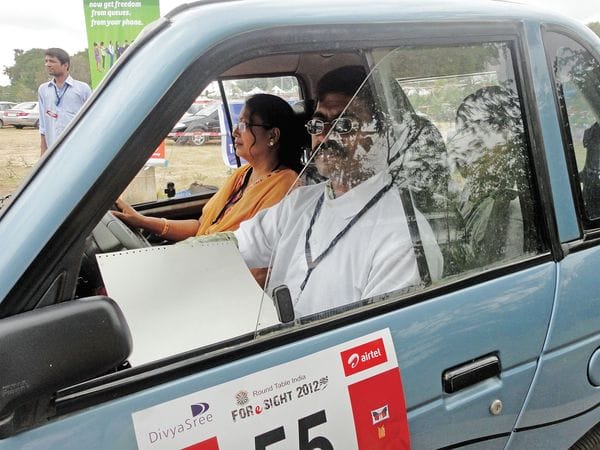
Navigator Keshava Murthy all set with his Braille route to start off the Rally. Pic courtesy: S Srikarunya

The organisers, 90 degree (an event management firm) and the National Association for the Blind, Karnataka teamed Rathiga with Keshava Murthy, an employee of Columbia Asia Hospitals and a visually challenged person. He was also the braille route reader for the rally.

Rathiga’s co-driver was Mitresh S, a class VII student of Baldwin Boys High School. The co-driver is responsible for calculations based on time, speed and the distance to reach destination correctly, without penalties.

The blind car rally was a different experience for the participants with the event proceeds going towards many projects of the National Association of Blind.
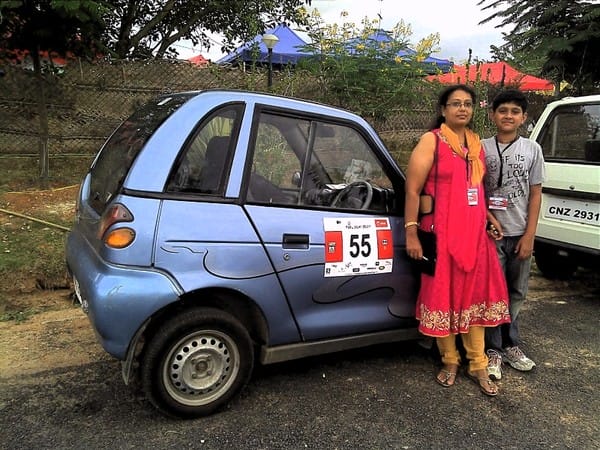
Rathiga with her co-driver at the rally. Pic courtesy: S Srikarunya

The route was on normal city roads and Rathiga drove 55 kms to close the rally with 12 penalties. Rathiga says she bought an electric car, as it is easy on her purse. "I spend about Rs 12 a day". She says she can independently travel to office, shop or visit friends. She adds, it is easy to drive and small, "I never feel guilty occupying too much space in traffic" and that it causes no pollution.

Rathiga signs off with a request to Bangaloreans, "Let’s be the leaders in reducing pollution. Save fuel by using public transport or eco vehicles and don’t forget – car pool".

Leave a Reply

Your email address will not be published. Required fields are marked *

Similar Story

Safety still out of reach: Everyday struggles of women with disabilities

Women with disabilities face increased risks in public and private spaces because of consent violations, unsafe surroundings and neglect.

Every morning, Samidha Dhumatkar travels from her home in Mumbai’s western suburbs to Churchgate, where she works as a telephone operator at a university campus. Her journey involves taking a rickshaw, boarding a train, and walking to her workplace, similar to thousands of other Mumbaikars who commute daily. However, as a person with a visual disability, Samidha’s commute is fraught with threats to her safety. In their book, Why Loiter? Women and Risk on Mumbai Streets, writers Shilpa Phadke, Sameera Khan, and Shilpa Ranade, argue that spaces are not neutral. Moreover, they are not designed equally. “Across geography and time,…

Similar Story

India’s stray dog debate puts the nation’s conscience on trial

Street dogs spark a national test — will India choose compassion or fear as law, humanity and coexistence come under strain?

At the heart of a nation’s character lies how it treats its most vulnerable. Today, India finds its soul stretched on a rack, its conscience torn between compassion and conflict, its legal pillars wobbling under the weight of a single, heartbreaking issue: the fate of its street dogs. What began as a Supreme Court suo moto hearing on August 11th has morphed into a national referendum on empathy, duty, and coexistence, exposing a deep, painful schism. Two sides Caregivers and animal lovers: They follow Animal Birth Control (ABC) and Catch-Neuter-Vaccinate-Return (CNVR). Their goal is to reduce dog populations and rabies…