For most of us, our domestic help are critical to managing our household work better and many of us recognise their importance. We also wish their wellbeing and often, we try to help them by contributing, over & above monthly wages, with tea, food, old clothes, festival gifts etc.
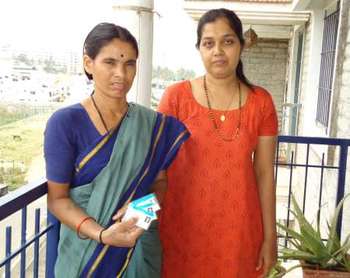
Sushila Amma with her Insurance card (left) with Urjita Lolla. Pic courtesy: Urgita Lolla.
However, not many of us are well aware of the major difficulty they face in managing their and their family’s health care. Since the conditions under which they live, make them easily susceptible to illness and they are often hospitalised for a day or two, and end up spending a few thousand rupees that is way beyond their paying capacity.
These women usually make the payments by taking a loan either from us, their employers, which we may grudgingly give, but mostly by borrowing from private money lenders. They then end up paying astronomical baddi (interest), which is normally 40% p.a or more.
For my housemaid, Sushila Amma, I have taken a medical insurance and personal Accident policy for her family of four by paying a premium of Rs 450 per annum under Universal Health Plan from Oriental Insurance Co Ltd. She gets coverage of Rs 30,000 annually for her and her family. If she had provided me with her BPL card (Below Poverty Line card) the premium would have been meagre Rs 150 per annum; unfortunately she does not have a BPL ration card.
Universal health Insurance is one of the insurance schemes announced by central government in their budget two years ago. This type of policy is sold only by public sector insurance firms like Oriental Insurance, National Insurance, New India Assurance and United India Insurance.
The requirement for getting a policy is a photo ID and address proof for the major members of family and photographs of all members for getting photo card for cashless hospitalisation from TPA (Third party Administrators). For postal address, employers can give their home address, so that getting courier will not be a problem.
For UHI Policy from Oriental Insurance, you can contact Koramangala Office: Raghuram Shetty, Branch Manager. Ph: 25634469 (dir), 25631719.
When I shared my thoughts with her other employers in our apartment, where Sushila Amma does housework, they readily agreed to share the premium cost.
This is something we can do in a small way that can have significant impact on the lives of people around us. I feels fulfilled, when I think about Sushila Amma and her family. I know that she shares this information to her fellow maids and neighbours, which in turn will create better awareness in general.
There many government health policies, education policy, poverty elevation programs etc, announced every now and then but reality is that the vulnerable class is not aware of the these, due to their illiteracy or lack of access to information.
It is our responsibility to educate, not necessarily en masse but atleast individually to the people we deal with, like domestic maids, drivers, milk suppliers, carpenters, security staff, house keeping staff etc.
⊕
Great work Urgita and good on you…