The cessation of the heavy monsoon rains seemed to herald a smooth run for the Ranga Shankara Theatre Festival. Bright sunshine greeted us as we walked to Ranga Shankara on 31st October, the first day of the Festival, as we ordered some of Anju’s delicious snacks and took a leisurely turn around the foyer, taking in the beautiful decorations, and the priceless photographs from the Company Theatre era, the period between the 19th century to mid 20th century. The opening play Nati Binodini dealt with one of the stars of that era, and her fearless expose of the exploitation women faced then. The Hindi play was indeed a wonderful vehicle to flag off the festival. Other plays in this festival include: Kathiaar Kaaljaat Ghusli (Marathi), Maya Bazaar (Telugu) and Begum Barve (Marathi), and two Kannada plays Jagajyothi Basaveshwara and Sadarame, specially commissioned by Ranga Shankara, which echo the grandeur of a bygone era.

Festival Poster (Pic: Deepa Mohan)
Even stalwarts such as Yenagi Balappa (all of 95 years), who set up the Kalavaibhava Natya Sangha, took the stage on Saturday, 1st November, as ‘Haralayya’ (instead of donning the title role as usual) after 25 years, in Jagajyothi Basaveshwara, with his son Yenagi Nataraj directing it.
Sunday saw a seminar on Company Theatre, with speakers including Amal and Nissar Allana (from the Marathi stage), Prof. Ramakrishna Marate (from Dharwad, where Company Nataka is alive to this day), Gudihali Nagaraj and Prof. SR. Ramesh (from Mysore), Dr. Sripad Bhat (from Haveri), and Malathi Sudhir, Malathi Mysore and Chindodi Bangaresh.
The Theatre Appreciation Workshop, moderated by Sadanand Menon, also has people from all walks of life getting together in their love for theatre of both yesterday and today.
‘Ranga Chitra’ has screenings of several documentaries that throw light on the theatre of that era. The films examine the lives of travelling actors across different parts of India. Naveen Kishore’s Performing the Goddess: The Chapal Bhaduri Story, MS Sathyu’s Gubbi Company; K Madhusudhanan’s Maya Bazaar – The Survival of a 120-year-old Theatre Family and so on.
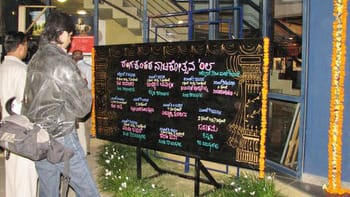
Ranga shankara theatre festival kannada board (Pic: Deepa Mohan)
Ranga Shankara also has some treats in store for us in the form of songs from the Company Theatre plays: Ranga Geetegalu (theatre songs)- an evening of solo performances by greats such as R. Nagarathnamma, Master Hirannaiah and Sarita Joshi during the next weekend (November 7,8,9).
With such a multi-faceted production of the plays and the surrounding features of the Company Theatre era, the Theatre Festival 2008 at Ranga Shankara is a vibrant showcasing that is a must-visit for avid theatregoers of Bangalore, and, indeed, Karnataka.
Unfortunately, the Ranga Shankara website does not seem to have followed suit. The ‘Annual Festivals’ webpage on their website is only updated to 2006, when the 2008 festival is more than half over! Surely something that Ranga Shankara has to look at carefully. In today’s internet world, information has to be, not just up to date, but up to the minute! However, when one goes and sees the spirit of theatre so vividly alive at Ranga Shankara, such lapses are easily forgiven. ⊕
Update about update: The Ranga Shankara Theatre Festival website seems to have been updated now.