Bengaluru runs the Ultra

More than one thousand people participated in the fifth edition of the Ultra Marathon. Here are the winners in the four categories.

The 2011 Bangalore Ultra Marathon took place on Sunday, 13 November, at Hesarghatta. The marathon, organised by Runners for Life, a community of runners, is in its fifth year. This year, the Ultra had five courses – 12.5, 25, 37.5, 50, 75 and 100 kilometres. The marathon was open to people of all nationalities.
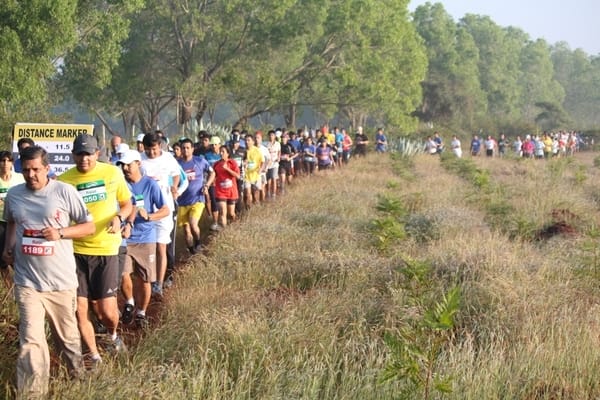
More than a thousand people participated in the Ultra Marathon. Pic courtesy: Veloscope

Winner of the 50 kilometre course of Bangalore Ultra Marathon, Athreya Chidambi, finished the race in 3 hours, 58 min and 56 seconds; missing out on breaking the course record by one minute. The thirty-three year old graphic designer has participating in the Ultra Marathon for five years now, winning the 75-kilometre course two years ago. Chidambi says that the trail was challenging but apart from sore legs, he is feeling fine. Speaking on his training routine, Chidambi says “I run once in the morning and then cycle to office. On weekends I go on long runs.” He cycles from his home in Cooke Town to his office on Old Airport Road, HAL.

Athreya Chidambi is the winner of the 50k category. Pic courtesy: Veloscope

Chidambi says that his aim was to participate in the 100-kilometre course but due to lack of preparation, was not ready. “I have participated in the 100 km before but this time I was not ready. There’s always a next time,” he says.

According to the official website, 1147 runners had registered in various categories. The race time differed for each category; 100 and 75k at 5 am, 50 and 37.5k at 6 am and 25 and 12.5k at 7am.

Results of the ultra marathon 2011

Leave a Reply

Your email address will not be published. Required fields are marked *

Similar Story

Safety still out of reach: Everyday struggles of women with disabilities

Women with disabilities face increased risks in public and private spaces because of consent violations, unsafe surroundings and neglect.

Every morning, Samidha Dhumatkar travels from her home in Mumbai’s western suburbs to Churchgate, where she works as a telephone operator at a university campus. Her journey involves taking a rickshaw, boarding a train, and walking to her workplace, similar to thousands of other Mumbaikars who commute daily. However, as a person with a visual disability, Samidha’s commute is fraught with threats to her safety. In their book, Why Loiter? Women and Risk on Mumbai Streets, writers Shilpa Phadke, Sameera Khan, and Shilpa Ranade, argue that spaces are not neutral. Moreover, they are not designed equally. “Across geography and time,…

Similar Story

India’s stray dog debate puts the nation’s conscience on trial

Street dogs spark a national test — will India choose compassion or fear as law, humanity and coexistence come under strain?

At the heart of a nation’s character lies how it treats its most vulnerable. Today, India finds its soul stretched on a rack, its conscience torn between compassion and conflict, its legal pillars wobbling under the weight of a single, heartbreaking issue: the fate of its street dogs. What began as a Supreme Court suo moto hearing on August 11th has morphed into a national referendum on empathy, duty, and coexistence, exposing a deep, painful schism. Two sides Caregivers and animal lovers: They follow Animal Birth Control (ABC) and Catch-Neuter-Vaccinate-Return (CNVR). Their goal is to reduce dog populations and rabies…