Hit, run and get justified

Would you step in if you hear screams of a woman from your neighbour's house?

Kannada Actor Darshan’s act of domestic violence has been in the news for the past few days. Yes it has not been proven, yes his wife has taken back the case. But the fact is his wife is in a bad shape and is attending court cases with her hand in a cast.

The case is pending before the Magistrate. Initial Police inquiry suggests that he attacked her in a moving car. The driver said he didn’t see or hear anything because the partition is sound proof.

What would you have done had you witnessed this happening while you drove past it?

Would you have tried to stop it? Would you have reported it to the police or testified in court as a witness? Or would you have said it is a spat between a husband and wife and so I will not interfere?
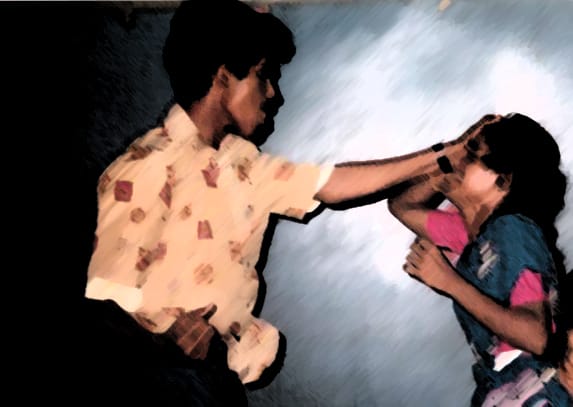
Pic Courtesy: Association for India’s Development
(A play to raise awareness of domestic violence)

Would you step in if you hear screams of a woman from your neighbour’s house?

Is it still a private affair when there is violence involved?

Reports say in 2010 more than 2000 domestic violence cases were received in Bangalore alone under the Domestic violence Act. There might many more that have gone unreported. What does it say about the city’s people?

The people who are reading the news or watching this Darshan episode on TV are divided into two categories. Category one, that says why is it such a big deal that he beat up his wife? It must’ve been a spur of the moment thing, they’ll patch up. And the other category says he shouldn’t have done that, but take no action.

So that is how we view domestic violence. We either accept it as part of a marriage or condone it anyway by not taking any action.

Isn’t there are possibility of third category – the group that says domestic violence of any sort is not acceptable, even if it is just once?

Leave a Reply

Your email address will not be published. Required fields are marked *

Similar Story

Safety still out of reach: Everyday struggles of women with disabilities

Women with disabilities face increased risks in public and private spaces because of consent violations, unsafe surroundings and neglect.

Every morning, Samidha Dhumatkar travels from her home in Mumbai’s western suburbs to Churchgate, where she works as a telephone operator at a university campus. Her journey involves taking a rickshaw, boarding a train, and walking to her workplace, similar to thousands of other Mumbaikars who commute daily. However, as a person with a visual disability, Samidha’s commute is fraught with threats to her safety. In their book, Why Loiter? Women and Risk on Mumbai Streets, writers Shilpa Phadke, Sameera Khan, and Shilpa Ranade, argue that spaces are not neutral. Moreover, they are not designed equally. “Across geography and time,…

Similar Story

India’s stray dog debate puts the nation’s conscience on trial

Street dogs spark a national test — will India choose compassion or fear as law, humanity and coexistence come under strain?

At the heart of a nation’s character lies how it treats its most vulnerable. Today, India finds its soul stretched on a rack, its conscience torn between compassion and conflict, its legal pillars wobbling under the weight of a single, heartbreaking issue: the fate of its street dogs. What began as a Supreme Court suo moto hearing on August 11th has morphed into a national referendum on empathy, duty, and coexistence, exposing a deep, painful schism. Two sides Caregivers and animal lovers: They follow Animal Birth Control (ABC) and Catch-Neuter-Vaccinate-Return (CNVR). Their goal is to reduce dog populations and rabies…