With I am, film director Onir, still best known for his debut film My Brother Nikhil gives us yet another piece of thought provoking cinema. The film is also a landmark venture for independent film making in India, with the financing for the film being raised from over 400 individuals, many of whom made their donations through social networking sites like Facebook.
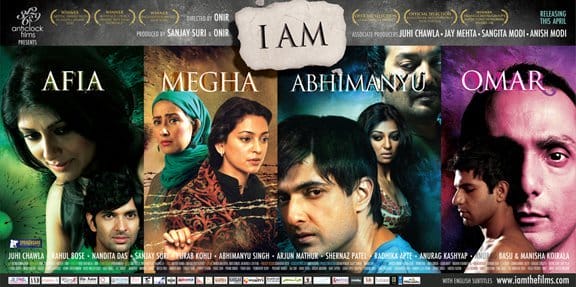
The film’s narrative takes the form of four stories that explore the themes of women’s choice in artificial insemination, separatism in Kashmir, child molestation and homosexuality. These are the stories of "Afia", "Megha", "Abhimanyu", and "Omar" – all of whom are joined by fear that can only be redeemed when they reclaim their lost selves.
As with My Brother Nikhil, Onir brings topics that are often consigned to the margins, into Hindi cinema’s mainstream discourse with courage, conviction and sensitivity. Yet the approach is never didactic. Instead, in each instance, he crafts a ‘tale with a twist’ that celebrates the art of storytelling.
Onir is ably supported by a cast that includes Nandita Das, Juhi Chawla, Manisha Koirala and Rahul Bose. Juhi and Manisha return the silver screen after a long hiatus, and do not disappoint. It is also a landmark film for Rahul Bose, who is the face of one of the most honest portrayals of homosexuality and its exploitation seen in Hindi cinema.
Yet this remains a film where both the director and his talented actors hold their own, while the audience is drawn in by original screenplay and editing that never loses sight of the spirit of the film.
The end product is well crafted, introspective, intelligent cinema that looms tall over much of what we see in contemporary Hindi cinema. My rating for this film would be 3.5 on 5. Definitely a film worthy of an evening at the cinema.
The ratings and what they mean
The ratings are on a scale of 1 to 5 and try to strike that difficult balance between cinematic critique and giving the regular film buff a peek into what’s playing in town and worth a watch.
1: Watch this film only if the director pays you
2: You could safely give this film a miss
2.5: A one time watch
3: Good cinema. Money well spent
4: Great cinema. A standing ovation
5: Simply speechless. A masterpiece.
⊕