Karaga is one of the oldest festivals in Karnataka and is also celebrated in Tamilnadu. In Bangalore, the Dharmarayaswamy Temple in Thigalarpet (central Bangalore, between the City Market area and Richmond Town) has been the focal point of this festival. Karaga ran its course in the third week of April this year. These pictures were taken on the night of 20 April, a full moon.
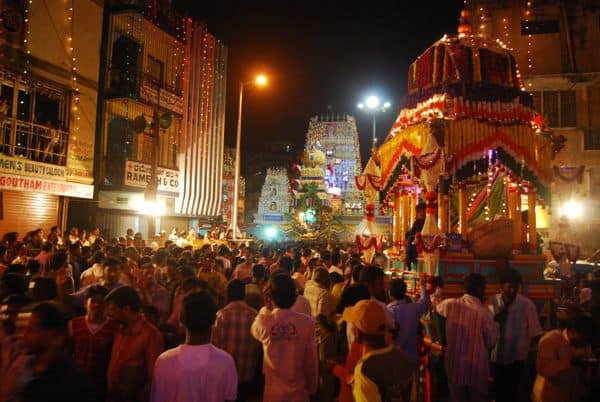
A huge crowd in front of the Dharmarayaswamy temple, this is the only entrance path used by the Veerakumaras and other followers. There were people as far as the eyes could see. People were on almost top of
every balcony and roof.

These are the Veerakumaras. They marched in hundreds from near the Corporation Circle towards the Dharmarayaswamy temple.

Carnatic exponent R K Keshavamurthy from Rudrapatna; he was sitting at a vantage point from where the Dharmarayaswamy temple was visible also and the proceedings. The music
was broadcast on huge PA systems and was heard all over the area.
About Karaga
Adishakti Draupadi is the community deity of the Vanikula Kshatriya Thigala community, and Karaga is the 9-day festival observed by them in reverence to the Goddess. The Thigalas believe that Draupadi Shakti (power) brims over during the Karaga festival and the Karaga carrier dressing as a female is symbolic of Draupadi.

This was a procession of another god that started somewhere near Minerva
circle. There was a number of processions like this and all of them finally ended up near the Dharmarayaswamy temple.
The karaga itself is a mud pot, on which stands a tall floral pyramid that is balanced on the carrier’s head. The karaga-bearer himself symbolises goddess Draupadi and is therefore adorned like a woman. The karaga-bearer leaves the temple around midnight. The goddess is brought for the darshan of the devotees from the temple on the head of the karaga-bearer.
The festival’s route in Bangalore begins at the Dharmarayaswamy temple and snakes through the old city via Cubbonpet, Ganigarapet, Avenue Road, Dodderpet, Akkipet, Balepet, Kilari Road, Nagarathpet and surrounding areas.
The karaga is expertly balanced on the carrier’s head. The carrier, in his temporary avatar as Draupadi, goes to the houses of the Veerakumaras where their families perform pooja to the karaga. The carrier is practically in a trance even as he dances along with the Veerakumaras (who are carrying their swords). By the time the procession returns to the temple it is dawn. ⊕
References
Text for this feature is courtesy of Wikipedia and Karaga.org. Citizen Matters has not checked the validity of any interpretations, and does not make any claims to its authoritativeness.
Excellent coverage.Wish I had been able to go there…but practicality intervened!
Superb stuff 🙂
I just registered on Citizen Matters. The Karaga pictures caught my eye. I couldn’t attend the night festivities, but went in the morning for a while and took some pictures.
I don’t know if this is permitted here… I will put it in anyway. I am sure I will find out if it is appropriate!
I have just started blogging on Geography and the first entry was on Karaga. You can read it here: http://tiigs.org/blog/?p=60